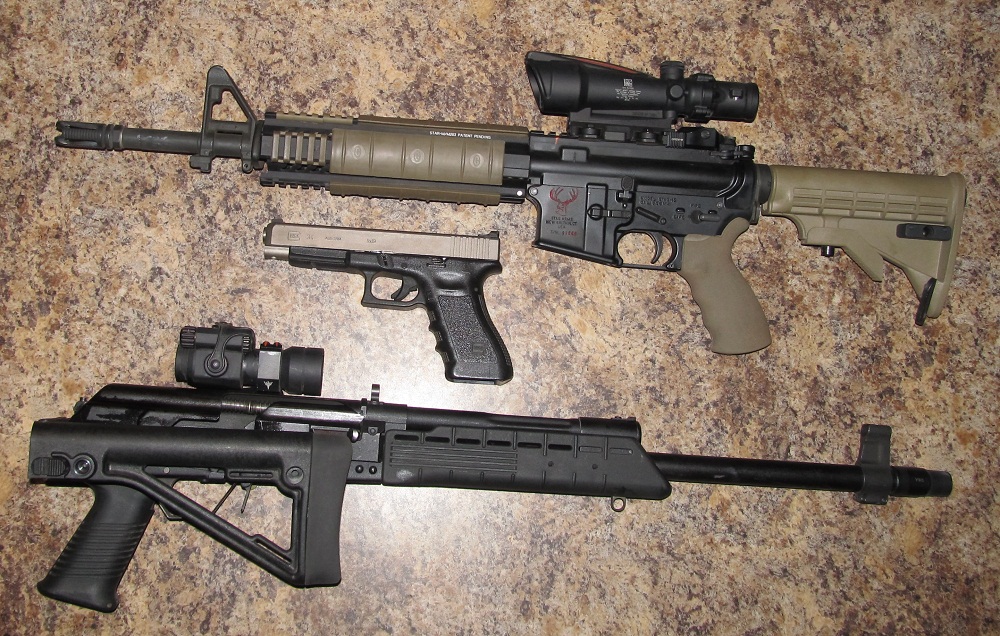
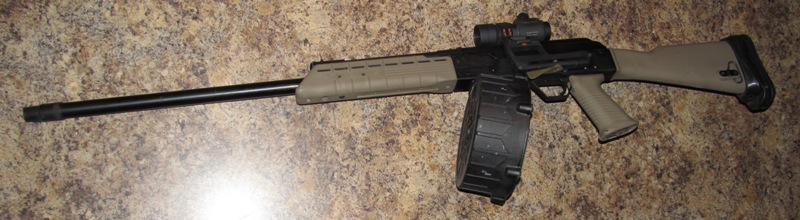
I used my AK underfolder I won from East Valley Class 3 this month. I added an Aimpoint M2 in Midwest Industries Mount. I don’t really care for the AK underfolder stock, but with the Aimpoint in place I don’t have to jam my face down on the stock so hard to use the sights. Adding a red dot to anything makes it much easier to use effectively, and this AK was no exception. I placed surprisingly well with it, in part I think to using the Saiga-12 so much recently with the sights and operating controls being similar.
Phoenix Rod and Gun 3 Gun
I used my SCAR-H in a match for the first time in Tactical Limited with an Aimpoint M4. My scores on the rifle stages were on par with other shooters using AR15s. So again I don’t feel that using this particular 7.62mm platform is noticeably more difficult than using an AR15 carbine.
I attended the 2012 Ironman 3 Gun Match in Parma, ID June 3rd-5th, competing in Trooper Division. Ironman sets itself apart from other 3 gun matches with its high round count and long stages; it is roughly triple the round count of other major events. Trooper is unlimited in terms of equipment restrictions; there are none, but competitors must carry all their gear from stage to stage on their person. You can see all the equipment I brought for the 2012 match here.
The match was well organized and ran efficiently. Shooting started at 7AM and we were generally done shooting before 7PM with two stages before lunch, and 2 more after lunch on days 1 and 2. Day 3 left us with 2 stages before lunch and one after lunch then awards/prizes. The weather in Parma, ID is very erratic and competitors need to bring clothing to deal with anything from freezing rain to temperatures in the high 90s. The second day of the match got into the high 90s, but at the end of the day storms rolled through with 45+mph winds that lowered temperatures dramatically and caused the match to shut down early (too many targets blowing over). The last day of the match was in the 50s with constant rain and wind. Despite the bad weather, the match continued on schedule.
Trooper Victories and Casualties
Trooper division had more participation than ever with at least 31 competitors starting in the division. Trooper gets bigger every year with more highly skilled competitors. As one of the founders of Trooper, this is something I am glad to see even though it means my personal chances of placing high are reduced. Competing against the best is one of the best things about the sport. Ben Fortin dominated Trooper division winning first place and high military category. He was followed by Travis Gibson in second Sean Smith in third. Complete match results are posted online here. I placed 6th, which is better than I expected given the level of competition at the match and some of the equipment issues I had (described below).
Several troopers were lost due to disqualifications for various reasons; including dropped guns or abandoning a gun that was still loaded with the safety off. Ironman is a marathon, not a sprint; It is well worth it to slow down slightly to make sure you do everything safely and make it through the entire match. Equipment problems cause attrition even amongst the best competitors. Iian Harrison, who has regularly placed in the top 3, unfortunately had to drop out of Trooper and move to Open division when his Saiga-12’s fire control became inoperable, and he did not have spare parts or a spare Saiga-12 carried with him. Shotgun breakages are the number one reason why competitors have had to drop out of Trooper over the years. Another competitor on my squad had the floating dust cover on his Saiga-12 break off inside the action and prevent it from cycling. I remove these from my guns due to this possibility and it also allows spent casings more room to eject. I was able to coach him through field stripping his gun on the clock and getting the debris out and the gun back into action.
Videos
I used my vio POV HD for most of the stages this year. Overall I liked used it and the quality of the video. I did miss recording two of the stages with it though, so stages 2 and 10 are low res substitutes. Watch the videos below with captions/annotations on as I explain whats going on during the stages. If you have not attended an Ironman watch them all to get a good idea of what is in store for you at the match.
Stage 1
Stage 2
Stage 3
Stage 4
Stage 5
Stage 6
Stage 7
Stage 8
Stage 9
Stage 10 (my camera didn’t record this one, so here is Don’s run)
Stage 11
Ammo Expended
Pistol
Rifle
Shot
Slug
Buck
Minimums
328
300
225
61
0
Ammo taken
800
800
350
105
30
Ammo left over
339
252
89
20
30
Ammo Expended
461
548*
261
85
0**
*I had to reshoot Stage 10, they called the match due to weather while I was shooting the stage, so I shot more rifle than I would have otherwise.
**No buckshot required or allowed on most stages this year
I took enough ammo so that I didn’t worry about running out, and not so much that it was overly burdensome to carry. Shooters considering participating in Trooper should consider their hit ratio at local matches and use that to determine how much extra ammo to take.
Self-Analysis
After each Ironman match I always analyze what I need to work on for next year. The biggest thing I did wrong this year was not use the same set of equipment for 3-4 months for all local level matches prior to going to Ironman. In years past I have done this, and not only does it make me more comfortable and familiar with everything I am using, if there is going to be a problem I can identify it earlier. I did not follow this practice this year because until the end of April I was preparing for the Tiger Valley team match and used different equipment partly due to rules for that match, and partly based on the problems/conditions faced in that competition. It’s hard to prepare optimally for two major matches so close together.
Equipment Issues
1) Slug Accuracy.
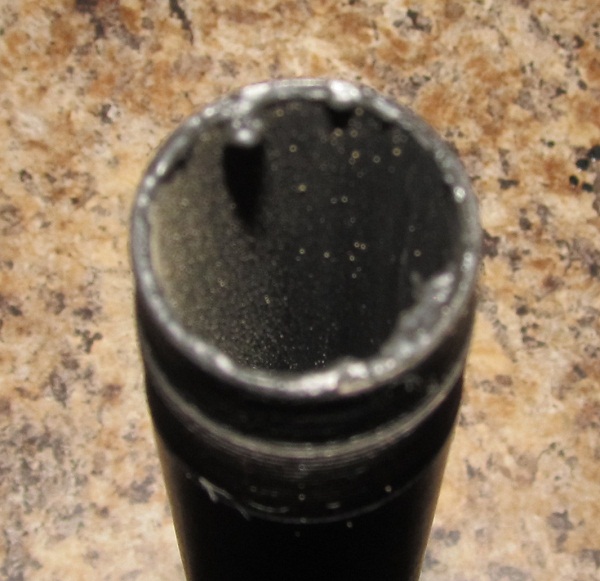
My slug accuracy started out bad and got worse as the match progressed. From the bench sighting in the best I got was a 5″ group at 50 yards. I thought this was good enough given that we normally shoot at large steel plates and the smallest slug targets are 10″ plates at the match. It ended up not being good enough. I wasted a lot of time and ammo on slug double spinners at 50-70 yards. The double spinner has a 8″ plate on top and 10″ plate on the bottom. It must rotate 360 or a 60 second penalty is incurred. Slugs normally rotate it in 2 hits, but I had to expend 10-15 shots on many to get my hits. By the end of the match my slugs were flying so erratically hitting the 18″ steel plates at 75 yards was a challenge. I pulled my choke off the end of the barrel when I got home and found a large amount of lead build up at the end of the barrel in the transition between the choke
I zeroed with slugs again after removing the chokes and the groups are now much better with the slugs touching or almost touching.
2) Primary rifle not reliable.
The primary rifle I intended to use had less than 1000 rounds through it when I took it to Ironman 2012. It had proven accurate and reliable at two local matches. The first stage of Ironman I had multiple failures to feed the next cartidge. The bolt fully extracted and ejected the spent casing, but would not chamber the next cartridge. With this being an intermittent malfunction, it was hard to diagnose, but I believe it was primarily from using a buffer that was too heavy with PMC .223 ammo which is not as hot as other .223 or 5.56mm loads. Another competitor on my squad experienced the same malfunction with the same ammo and buffer combo in his rifle, also intermittent. His rifle also ran reliably in AZ but not so up in ID. Fortunately I brought a spare rifle and used it for the rest of the match and it ran flawlessly. At the very end of the match I loaned my back up rifle to a Tac-Limited shooter whose rifle broke at the start of a stage and it ran fine for him too. I installed a lighter buffer when I got home and the primary rifle now runs reliably.
3) Saiga-12 feeding device malfunctions
My MD Arms drum malfunctioned on the first two stages, so I ditched it. The spring likely needs to be wound tighter. I had two malfunctions with my standard 10 round magazines due to weak springs; I’ve been using the same mags for 4-5 years and should have replaced the springs a while ago. The gun itself was reliable, this is the first time I’ve had zero malfunctions that were the fault of the gun itself with the Saiga-12 at Ironman.
Things to do differently next year…
1) More training, more exercise.
This year was the least effort I have put into preparing for the match in a long time and while I still placed reasonably well, I was not happy with myself for how I did on several of the stages.
2) Bring a Pistol Caliber Carbine.
Troopers can use Pistol Caliber Carbines instead of rifle and/or pistol on many stages. There were a lot more opportunities to use them to great effect this year. I had brought one a couple years in the past, but after getting my red dot Glock ended up not using one. This year the advantages of the PCC were obvious as several competitors on my squad used them to great effect; particularly on double spinners. They could get 3-4 hits on the plates in the same time it took me to get 2.
3) Bring a .308 rifle
A .308 is definitely not required, but I feel that it may be an advantage or help solve particular shooting problems. The rifle double spinners and dueling trees were handled much more easily by the competitors with .308s that I witnessed. There was not much close range rifle hosing where a .308 would have been a disadvantage, particularly when I could have used a 9mm carbine on those portions. Trying different combinations of equipment is one of the things that I find intellectually stimulating about competing.
The Ironman 3 Gun is a one of a kind competition shooting event. Every competitive shooter should go at least once. It gives me something to look forward to every year and focus my efforts towards self improvement and trying new types of firearms and shooting technology. If you’re planning on going to Ironman 2013, or even 2014 the time to start getting ready is now.
I get a lot of questions from people interested in Trooper division about what kind of gear I use or what I recommend taking. The firearms and gear I use work well for me as a total system, and may not work as well for someone else based on their shooting techniques, stature, or physical fitness. Consider the following as a guide for things to consider for your own Trooper gear.
Primary Guns
These are the guns I intend to use at Ironman 2012
Rifle:
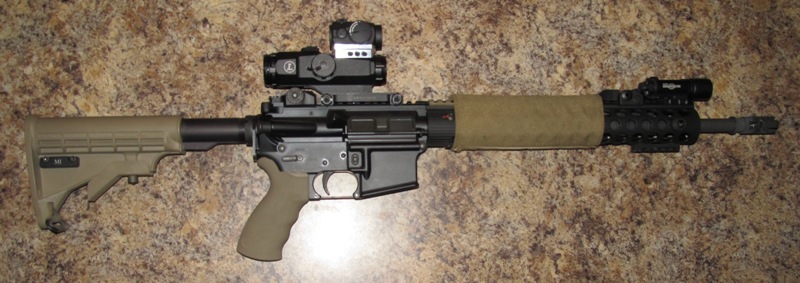
Upper: 16″ Palmetto State Armory with Primary Weapons FSC556, Troy Alpha Rail, and Coyote Tactical Fore End Wrap
Lower: Quentin Defense with CMC match trigger, VLTOR A5 buffer system, Ergo Grip, CAV-MFG stock.
Sights: Leupold HAMR with Aimpoint Micro in Hahn Precision Mount. Troy front BUIS, Hahn rear BUIS
Shotgun:
Saiga-12 DIY Conversion. SGM Modified Choke, RS Regulate Mount with Aimpoint M2, Tapco stock set, King Armory Gas Piston.
Pistol:
Glock 34 with OST-TSD Trjicon RMR coversion. Nickel Boron coating by WMD guns.
Back Up Guns
Unfortunately I did not have enough time on all my primary guns before Ironman this year. I am taking all these as back ups in the event I have a problem with any of the primaries. I was fortunately able to diagnose an intermittent malfunction in my primary rifle and fix it by replacing a weak extractor spring before going to Ironman. Because I am bringing these and carrying them with me from stage to stage, I probably won’t need to use any of them. Every time I carry spares I never need them. I am not superstitious about many things, but I am a firm believer in Murphy’s law. It’s a good thing the farthest hike is only a half mile round trip.
Rifle:
Upper: CMMG 14.5″ midlength with permanent flash hider, Samson rail.
Lower: Stag Arms, CMC Trigger, Carbine H2 buffer, Ergo Grip, CAV-MFG stock
Optics: Trijicon TA11J and Aimpoint M4s in LaRue mounts. The M4s is in my ruck.
Shotgun:
Saiga-12 DIY Conversion. SGM Modified Choke, RS Regulate Mount with Aimpoint M2, Tapco stock set, AGP Side Folder, King Armory Gas Piston.
Pistol:
Glock 34 with Warren Tactical/Sevigny sights.
Magazines
Bring enough to shoot each stage, bring enough to be able to finish the match if a couple die or are damaged on the stages.
There are no restrictions on magazines capacity in Trooper. 30 round glock mags make for less reloads. I still bring standard capacity magazines to deal with stages where a 30 rounder is a liability; i.e. shooting prone.
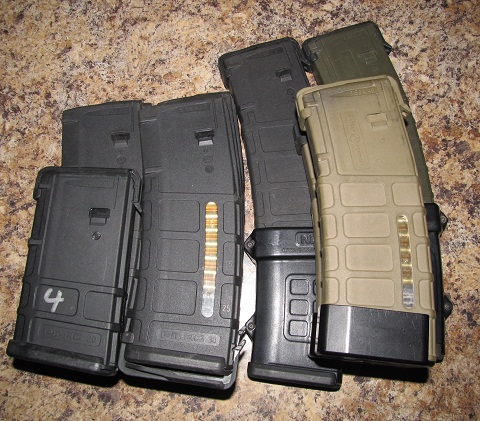
Five 30s, One 20, two 44s, one set of mag cinched mags to use as is most advantageous based on stage design.
One 20 round drum, ten 10 round AGP magazines for the Saiga-12
The 20 round drum is ungainly to reload with, I only use it at the start of the stage. The 10 round magazines I download to 9 rounds to make it easier to load on a closed bolt. The mag bandolier is useful for the few occasions I need more mags than my vest carries.
Ammo
Published round count minimums:
Rifle 300, Pistol 328, Shot 225, Slug 61, Long Rang Rifle 15
I don’t like worrying about running out of ammo, so between my vest, pack, and ammo can I’m bringing;
Rifle 800 (I dont take a separate long range rifle), Pistol 800, Shot 350, Slugs 100, 30 buck shot
I typically end up with 1/3 left over.
Maintenance
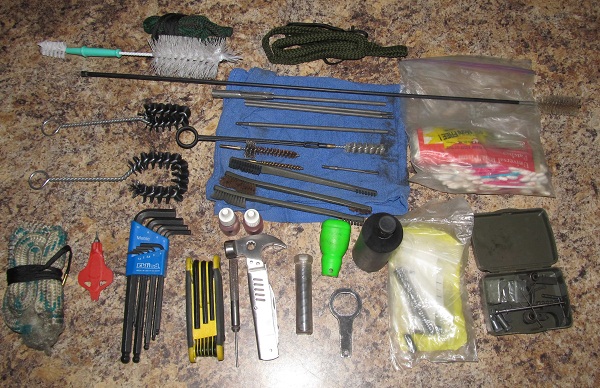
Cleaning supplies, tools, and spare parts. The range in Parma, ID has fine moon dust like sand that can coat everything if the wind picks up. One of the things many competitors overlook is brushes to clean magazines out after they get thrown on the ground.
Protective Gear
Arctyrex Knee Pads are lightweight, secure and effective. I find knee pads let me get into shooting positions more aggressively.
Mechanix gloves with and without fingers. I use the fingerless gloves for most stages, unless I need to hold onto a rope or carry something abbrassive. Either way the amount of shooting at Ironman wears on your hands, and having gloves makes it easier to get into and out of pron positions faster. In particular wearing gloves makes shooting the Saiga-12 less painful with all the sharp edges on the AK design.
Wiley X ROUT prescription sun glasses, and clear safety glasses. Lighting conditions vary throughout the match and include some low light areas like killhouses and tunnels. I really like these glasses because they have a large usable lens area which makes seeing clearly from different shooting positions a non-issue.
I wear calve supports to prevent strain. The rapid acceleration and decelartion required by action shooting has caused me calve strain in the past. Not only do I want to prevent injury, but I want to minimize soreness over the course of the match so I can do my best on each stage.
Peltor ear pro with mount for my POV cam
Organization
Spec Ops Brand organizer bags that go inside my ruck. One for shotgun ammo, one for rifle and pistol ammo, one for maintenance.
Snacks
The only food Troopers can eat aside from lunch, while on the range is whatever they carry with them. Rehydration drinks and candy are a particularly good idea
This was a pretty big turn out for a local match in the summer heat. The demand for rifle/pistol matches is strong. If a similar match was held in Phoenix I think it would have 60-80 shooters easily.
I used the Leupold HAMR/Aimpoint Micro with Hahn Precision Mount on my rifle. I like this setup, and will like it even better when switching between optics becomes second nature for me.
I also used my OST-TSD Red Dot Glock as well for the first time in almost a year.
I’ll be using both guns at the Ironman 3 Gun Match in a couple weeks.
Posted inCompetitions|Comments Off on ACTS 5-19-2012
This was my first match using my rifle with the Leupold HAMR and Aimpoint Micro attached to it with the Hahn Precision mount. As you can see in the video above it worked well on the close range and long range stages.
Saiga-12 with 20 round drum and Aimpoint M2 in RS Regulate mount made the shotgun stages simple.
Posted inCompetitions|Comments Off on Rio Salado Multigun 5-12-2012
TIGER Valley hosted its 4th annual 4 man Tactical Team Match April 28th-29th 2012
Nine teams competed, including two from Arizona.
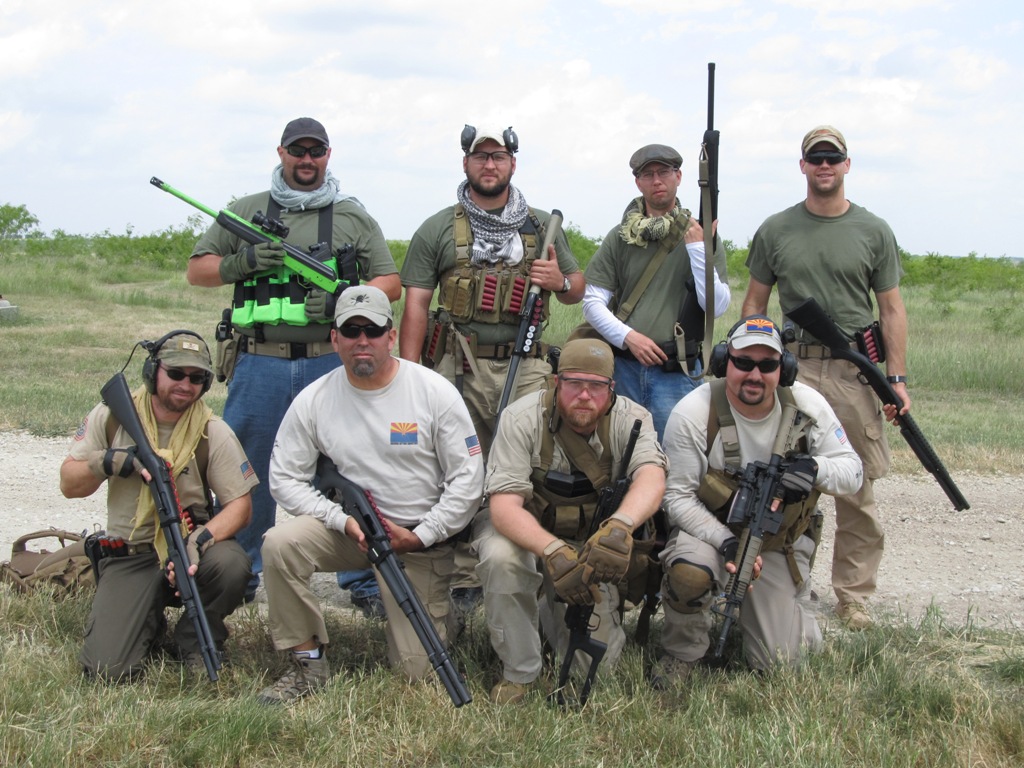
Front Row Team Arizona Action Shooters (left to right): Don, Mark, Karl, Russell (author)
Back Row Arizona B-Team (left to right): Paul, Brad, Jake, Reid
The match featured 8 stages that tested team work, physical fitness, and marksmanship. Over all score was based on match points. The fastest time or most targets hit on each stage got a team 100 points; everyone else’s score was calculated as a percentage of the best score per stage.
Dallas SWAT dominated the match winning by 95 match points.
Arizona Action Shooters was 3rd place, and Arizona B-Team was 4th place.
Scores:
(If anyone that participated wants me to include their team name, send me an e-mail).
Teams were able to pick to a great degree which team members complete which tasks on the stages. This allowed us to play to our strengths. We generally had two guys with long guns (rifle or shotgun) and two guys with pistols on most of the stages. Shotgun was also much more prominently used at the 2012 match compared to previous years. Having two team members with Saiga-12s was of particular advantage because guns had to be completely unloaded until in the shooting area, then cleared again rapidly.
We were able to run 2 POV cameras on team Arizona Action Shooters to get a more complete view of all the stages. I used a ContourHD, and Don used a Vio POV 1 (non-HD). I edited the view back and forth to show what was going on at the same relative time.
Here are all the videos of team Arizona Action Shooters:
Stage 1: 100 Match Points
Stage 2: 100 Match Points
Stage 3: 58.6 Match Points
Stage 4: 68.1 Match Points
Stage 5: 81.4 Match Points
Stage 6: 67.6 Match Points
Stage 7: 97.2 Match Points
Stage 8: 92 Match Points
TIGER Valley’s 4 man tactical team match is a one of a kind event open to the public. There simply is not another venue for this type of competition. Action shooting competitors wanting to take it to the next level, or students of tactical schools wanting a solid annual test should attend this match and compare themselves to the professional teams that show up.
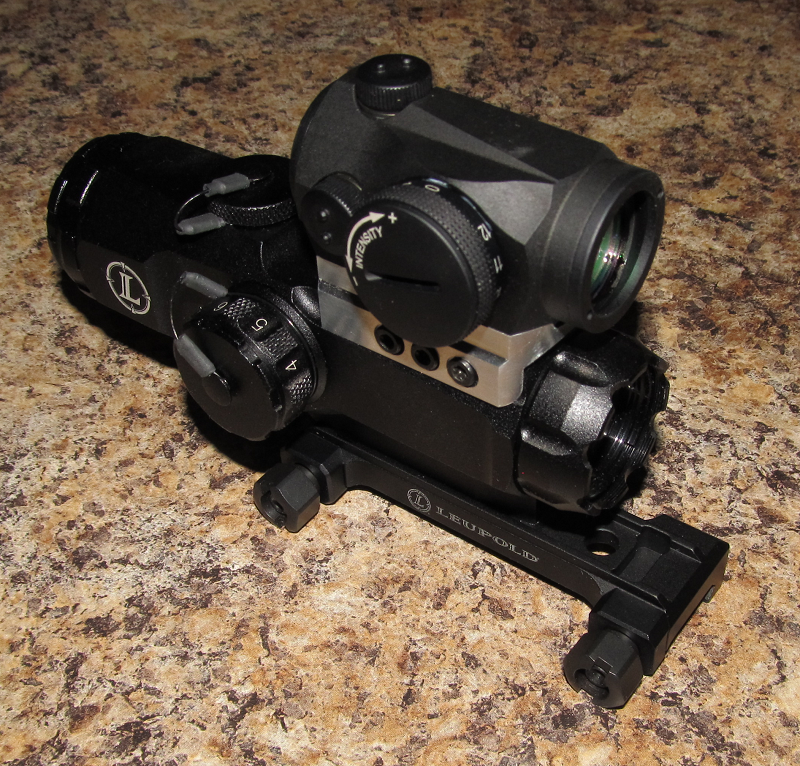
Leupold’s HAMR scope is a relatively new entry into the market for low-fixed power optics, competing most directly with the Trijicon ACOG. You can read all about it here on The Firearm Blog. I have had a HAMR for a few months now and the things I like about it most are the long eye relief and adjustable brightness reticle. Another noteworthy feature is the mount has different screw holes that allow the user to adjust how far forward or back the scope sits in relation to the shooter’s eye while remaining in the same rail slots.
The HAMR I purchased came with the Leupold Delta Point reflex sight mounted on top at the front of the scope. Leupold’s choice to mount the reflex sight forward on the HAMR is much more user friendly than mounting it at the rear like the ACOG. I have previously used a Doctor Optic mounted on top of an ACOG, and I constantly had the bill of my hat banging into the Doctor when I used the ACOG. This was distracting and the primary reason I did not stick with the ACOG/Doctor Combo.
Unfortunately, while I like the position of the Delta Point on the HAMR, I do not care much for the sight itself. Zeroing the delta point was a frustrating experience. It uses very small screws for the windage and elevation adjustments and two small screws to lock those in place. With the Delta Point mounted on top of the HAMR loosening those locking screws was challenging. I had to remove the Delta point to have sufficient leverage to loosen them. Adjusting windage and elevation was also tricky because there is just gross screw adjustments; not clicks for known measurements. When compared to the Trijicon RMR LED model (the most directly competing sight), the Delta Point is lacking in ease of use. The Delta Point is slightly smaller and about $100 cheaper, but the ease of use of the RMR offsets these disadvantages.
When I am competing in Open or Trooper divisions, I like the option of a red dot for close range stages. I also prefer the secondary red dot mounted on top of the primary magnified optic rather than offset so I can use it off either shoulder; stage design often forces me as a lefty to shoot right handed. I was disappointed that the Delta Point on the HAMR was not the solution I had hoped it would be. Fortunately Hahn Precision is working on a mount that allows the use of an Aimpoint Micro on top of the HAMR. The Aimpoint Micro is an extremely rugged sight with easy to adjust windage and elevation and adjustable brightness. Furthermore the closed tube of the Micro will not gather dust/debris like the Deltapoint or RMR when exposed to the elements. The Aimpoint Micro is a natural companion optic for a military grade sight like the HAMR. Pictures of the prototype system are below. I am looking forward to using this system in the near future.
Posted inGear|Comments Off on Hahn Precision Aimpoint Micro Mount for HAMR
Two of the matches I have coming up have rules that allow you to reconfigure your guns if you carry the different optics or accessories with you for the duration of the match. I have been primarily using a Trijicon TA11J the past several months, but sometimes a stage might be a lot easier to shoot with an Aimpoint due to the unlimited eye relief. Having to shoot with a gas mask or paintball mask on, or from very awkward positions is something I’ve done in the past where using an Aimpoint would be an advantage. Conversely, I much prefer the ACOG for 150-400 yard shooting. The LaRue mounts I have on both optics return to zero reliably so I am not worried about swapping them back and forth as needed.
I asked Coyote Tactical to make me a pouch that could accommodate either optic while the other is on my rifle. Pictured below is the final product:
The pouch is MOLLE compatible.
The lid is secured with velcro and padded
The body of pouch is supported by kydex and the kydex covered in soft material to support the optic.
Posted inGear|Comments Off on Optics Pouch by Coyote Tactical
I used my 14.5″ (permanent phantom flash hider) carbine with Trijicon TA11J for this match as I will be using it next week at the Tiger Valley Team Match. From watching others shoot the match this time, the main thing that put me in the lead was cleaner pistol shooting. On stage 1 I had 3 shots for 3 hits, and on stage 3 I only had 2 seconds added for -1 zone hits. Several people should have been faster than me, but when it got to the pistol portions they missed a lot or got a lot of time added on paper. Pistol shooting at ACTS is always very technical, and it pays to be able to shoot the pistol accurately at range when fatigued.
Posted inCompetitions|Comments Off on April 2012 ACTS Match
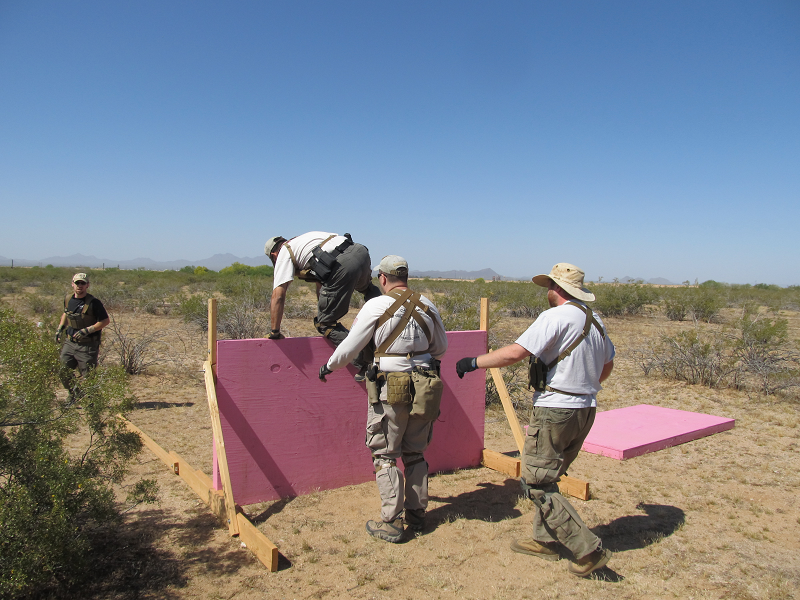
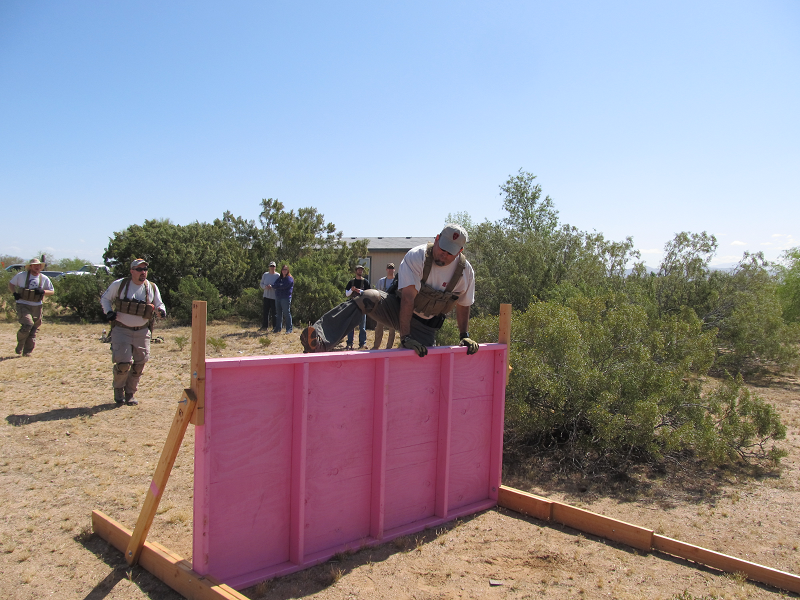
The Tiger Valley4 Man Team Match is just a couple weeks away. The match features a number of obstacles and physical challenges, that are as important to complete as quickly as possible as the shooting. Negotiating the obstacles efficiently at the match has been our weakness for the past 3 years. In an effort to be better prepared for the match this year, the two Arizona teams pooled their resources and built a wall similar to the ones encountered at the match to practice going over.
The wall prop is modular so we could practice going over it in 4 foot form as well as 8 foot form.
We trained with all the gear we will use at the match; if something is going to snag or get caught, better to learn it when score isn’t on the line. We did not carry our rifles with us as we have typically had to set them on the side of obstacles anyway for the sake of safety.
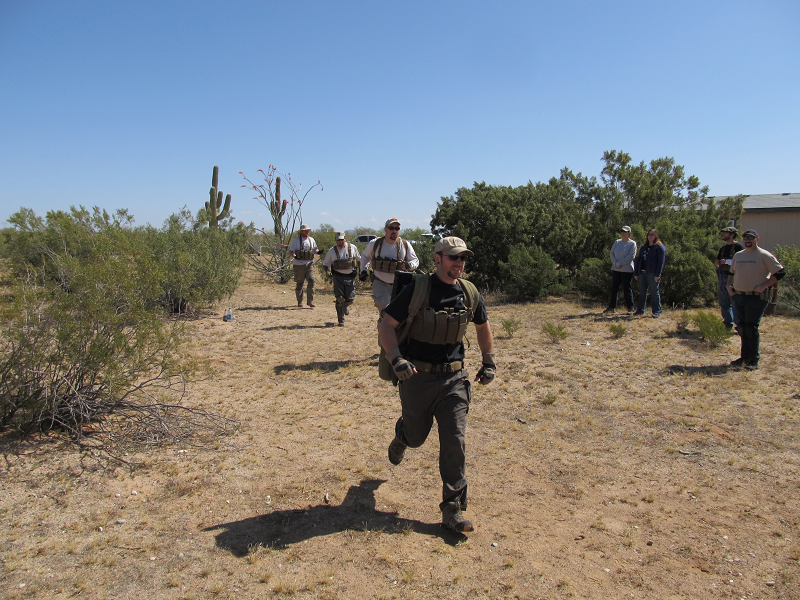
We ran laps and went over the wall as a team. Its better to let the fast guys get there first because by the time they’re over it, the slower guys catch up.
Reid demonstrates a good vault over the 4 foot wall.
Even with the ladder pack Don is faster than the rest of the team.
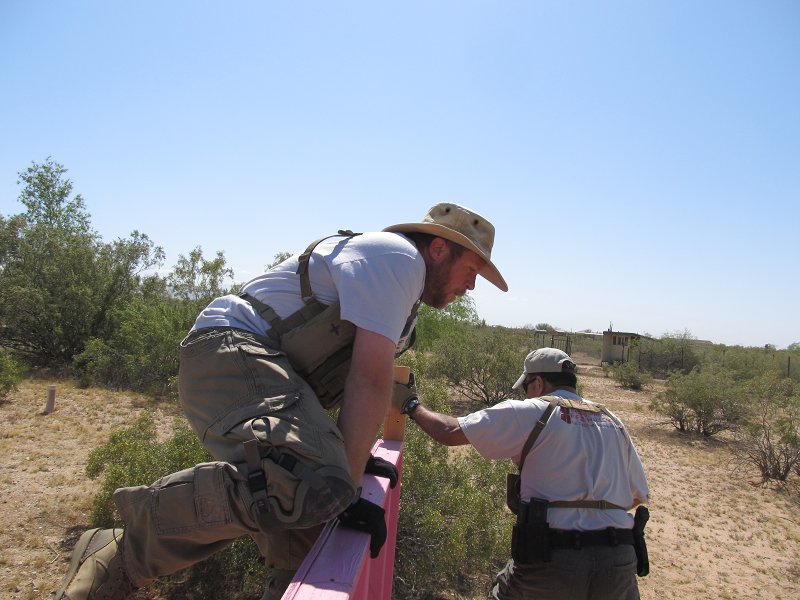
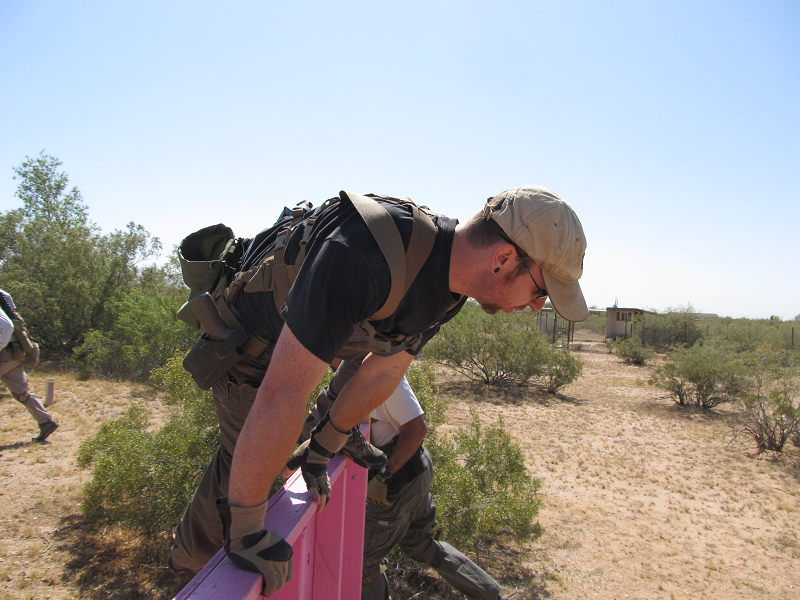
For some it is easier to get a knee up on the wall and roll over rather than get the whole leg up and vault over it.
Don easily vaults over the wall.
The ladder pack throws my balance off a little so its easier for me to get a knee up and roll over with it on.
Without the ladder pack it is a lot easier to get my leg up and pull the inside one through to jump over.
Mark also finds it easier to roll over the wall with the ladder pack.
Litter carry is part of the match, including over obstacles.
With the 8 foot wall assembled, Arizona B-Team man handles each other over it.
Reid is an animal and needs no help over the wall.
Team Arizona Action Shooters uses technology to solve the wall problem
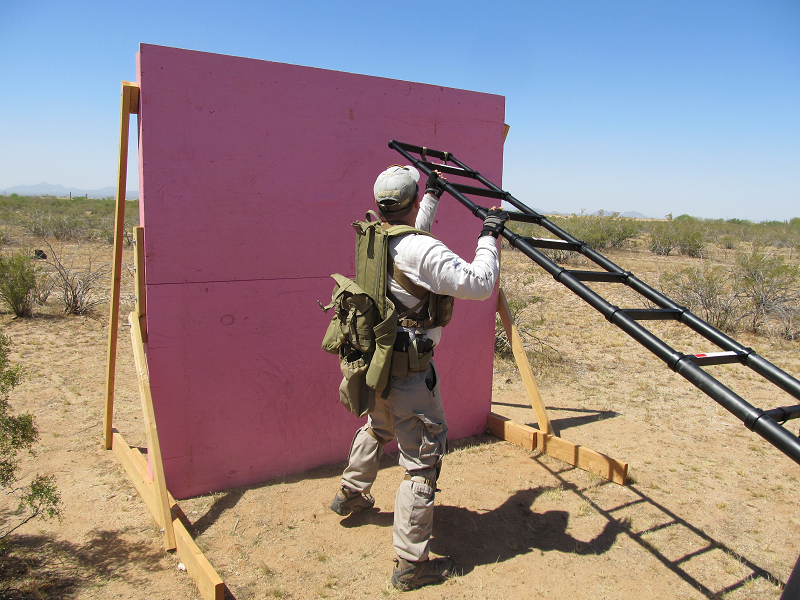
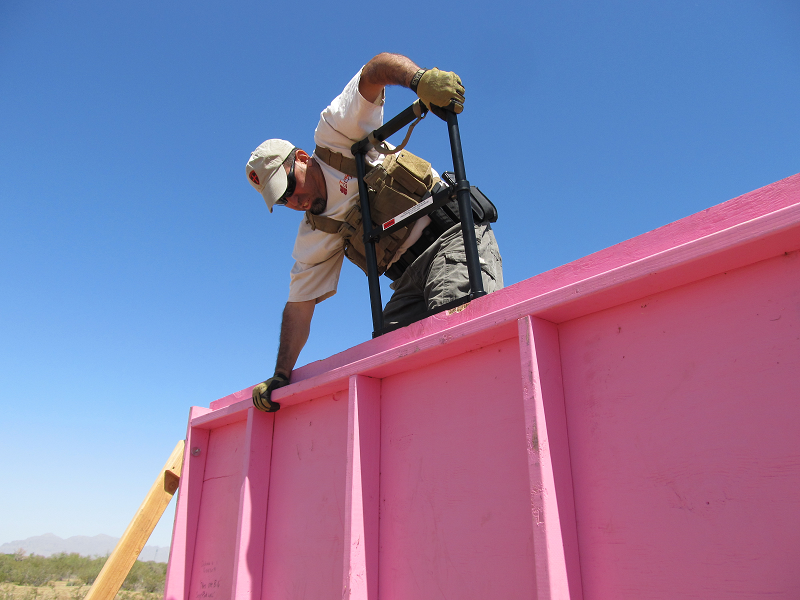
Tactical Ladder Deployed!
The wall was built to mirror the prop at Tiger Valley as closely as possible, including the plywood lip extending past the frame.
As the last man over I lift the ladder up and pull it down for team mates on the others side to retrieve and collapse…
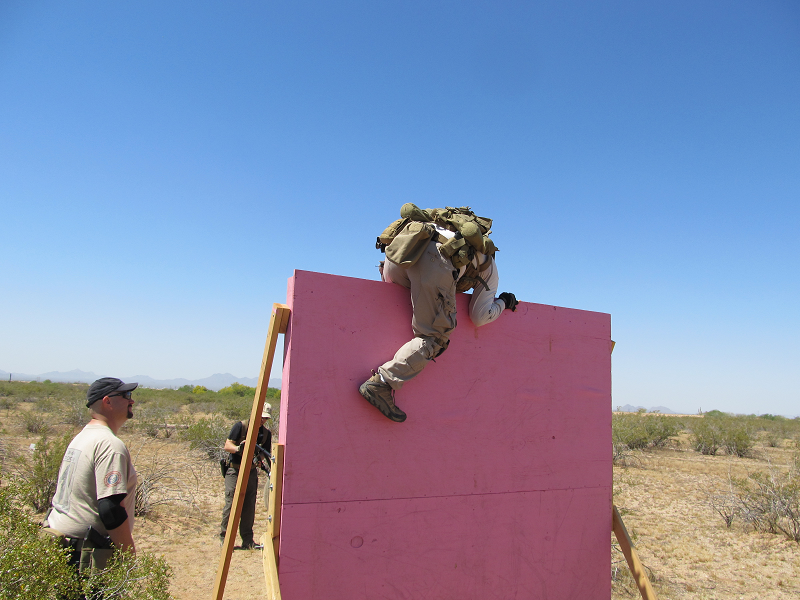
…then I roll over the top.
Practicing the mechanics of going over the walls made us all more comfortable with having to do it at the match and allowed us to address issues that could have cost us time during the real stages.
















 SinistralRifleman
You must be logged in to post a comment.