I wasn’t very interested in gettng a 7.62mm battle rifle until I handled a friends Mk17S SCAR-H. After shooting the SCAR-H, I was immediately impressed. For a .308/7.62mm NATO Rifle it is very light weighing in at just 8 pounds; about the same as some of my 5.56mm AR15s equipped with rail systems. The recoil is also more like that of a carbine gas system AR15, than a full size 7.62mm battle rifle.
I recently acquired my own SCAR-H. Thus far I am happy with my purchase. The SCAR-H is reliable and reasonably accurate with the ammo I’ve shot so far. The ambi controls and 45 degree selector will take some getting used to as a lefty thats always made do with unmodified AR15s (not a fan of modifying basic operating controls). I’m looking forward to trying out the new platform in some action shooting matches and testing new accessories for it coming out this year.
My SCAR-H outfitted with Aimpoint M4 and Magnifier in LaRue Mounts
There’s been been discussion recently on other blogs and forums about Saiga-12s, their reliability, modifications required out of the box, and durability. I was an early adopter of the platform, and started using them competitively in action shooting sports in 2006 well before it was “cool” to do so. There were some other shooters in Texas that were using them before that including fabricating their own magazines, but it really didn’t appeal to me until AGP Arms came out with their 10 round magazines and I was able to participate in beta-testing those magazines.
I used Saiga-12s very actively from 2006-2010 as you can see in the videos below.
Saiga-12 Highlights 2007-2008
I started using Drums in 2009
Halloween Shotgun Match 2009:
Loading magazines vs individual shells proves advantageous at Tiger Valley 2010 where freezing temps and wet conditions limited dexterity:
During that time I had many Match Wins and high placements using the Saiga-12
1st Place Open Division 2006 AZ State Shotgun Match
3rd Place Trooper Division 2007 Ironman 3 Gun Match
1st Place Trooper Division 2007 Michigan State 3 Gun Match
2nd Place Open Division 2007 AZ State Shotgun Match
3rd Place Trooper Division 2007 Fort Benning 3 Gun Match
1st Place Trooper Division 2008 Ironman 3 Gun Match
2nd Place Open Division 2008 Michigan State Shotgun Match
1st Place Trooper Division 2008 Michigan State 3 Gun Match
3rd Place Trooper Division 2008 Fort Benning 3 Gun Match
1st Place Trooper Division 2009 Ironman 3 Gun Match
3rd Place Trooper Division 2009 Michigan State 3 Gun Match
1st Place Open Division 2009 Halloween Shotgun Match
3rd Place Trooper Divisions 2009 Fort Benning 3 Gun Match
3rd Place Trooper Division 2010 Ironman Match*
5th Place Trooper Division 2011 Ironman Match
3rd Place Open Division 2011 Halloween Shotgun Match
The reason I mention all this is demonstrate that I am more than a casual user of the Saiga-12 and I’ve gotten a lot of trigger time with the system and given it more than a fair chance. I estimate that I have something around 15,000 rounds fired through Saiga-12s in total based on training sessions, test fire, and matches I have used them at.
In chronological order here is my experience with the Saiga-12 shotgun, representing 8 different guns that I have personally owned. Names have been with held as everyone that did work on my guns made it right in the end.
Gun 1 was imported with a 17.2″ barrel…it had to be sent back to RAAC under a mandatory BATF recall.
Gun 1 comes back it is ugly as hell with this welded on choke thing. I sent it to a reputable smith to be reworked into a pistol grip configuration and have a comp put in its place.
Gun 1 comes back, it now has plastic wadding shaving into the gas system making neat little hockey puck things. It goes back and forth to the smith a couple times and he gives me a new Gun, Gun 2.
Gun 2 runs great for about 1500 rounds. Then the plate that was welded on to attach the stock starts splitting off. Off it goes to the gunsmith for repair. I sold it when I got it back and got two stock Saigas Guns 3 and 4
Gun 3 runs great, and ends up serving me for almost 3 years with 9,000 rounds fired. (I will go over the maintenance log with that one later).
Gun 4 has crooked gas ports. It has intermittent failures. I never got the opportunity to fix this one.
Gun 5 is purchased to replace Gun 4. I send it off to a different reputable smith to be converted. It comes back and doesn’t work (it did before). Gunsmith fixes it. When I get it back I shoot it for a while, but it doesn’t run as well as Gun 3, so I sold it.
Gun 6 is purchased to replace Gun 5. Gun 6 is part of a faulty batch of imported guns with only 2 gas ports. Gun 6 is sent back, and the importer sends me Gun 7.
Gun 7 only has 3 gas ports and doesn’t run that well. Out of exasperation I have my machinist press the gas block off and drill another hole. Gun runs ok now with everything I shoot through it, just like Gun 3 did. It does like to malfunction with lighter loads when it starts getting dirty; maybe 1-3 times out of 100 rounds fired it will eject but not chamber the next round. Simply racking the bolt fixes the problem.
Gun 3 having seen several years of use and 3 Ironman Matches is starting to look worse for the wear.
Factory fire control parts wore out at about 3,000 rounds
Recoil springs have been replaced 4 times.
surfaces on the bolt and barrel extension are peening over and have to be polished.
The rear trunion has shifted significantly and the top cover only has 50% engagement.
The gun once fired merely by turning the safety off
Gun 8 is purchased to replace Gun 3. Gun 8 is about 0.040″ smaller in the receiver width than any of my earlier guns and it pinches AGP mags so they will not feed fast enough. It works with Surefire mags though which are apparently 0.025″ smaller in width than AGPs. After several hundred rounds fired and a few local matches I take this gun to the 2010 Ironman 3 Gun Match. I do not have any problems until during the match; the Surefire mags themselves proved to be unreliable and could not feed fast enough to keep up with the bolt speed. I assume that as the springs wore in they got weaker and just couldnt push the shells up fast enough. This left me with an empty chamber several times during the match with flying clays in the air; costing me 120 seconds in penalties plus time spent racking the bolt. In Trooper division we are not allowed to swap out equipment unless we carried it with us the whole time, I have to make do with what I have. I download my 12 round mags to 8 rounds to make them work, which resulted in a lot more time spent on reloads. The malfunctions with the Saiga easily cost me 2nd place.
Gun 7 still works, and I use it from time to time to train for the Ironman 3 Gun/Trooper Division. I am reluctant to use it hard because I don’t want to wear it out and there isn’t anything else out yet that I am ready to buy. When I do shoot 3 gun now, I often compete in Tac-Limited or Tac-Scope and use a Benelli M2 field that runs great and will easily last 100,000 rounds or more.
When Saigas, work they are AWESOME. I have won and placed in the top 3 of my division in several big matches because I was using a Saiga. I absolutely hate loading tube fed shotguns. I am however, getting sick of the maintenance cycle and going through on average 3 guns to find one that works well out of the box. If the gunsmiths can guarantee that your gun will run when you get it back from them, it may very well be worth the cost if you are lacking in patience and mechanical aptitude. All of these guns are different, even within the same batches, and you have to look at it as a project. I would only consider using a Saiga-12 if you are a serious 3 gunner and it will help with your score.
There is a market for a quality detachable magazine fed shotgun. Some gunsmiths and competitors are switching to the AKDAL MK1919 platform, saying it is more reliable and easier to work on. I’m going to wait and see what happens for a while before I invest in that system.
A recent BATF study on sporting shotguns makes it clear that detachable magazines alone do not make a shotgun “unsporting”, and domestic manufacturers should no longer be scared of Destructive Device rulings. Its time for American manufacturers to step up and make a reliable, durable, detachable magazine fed shotgun. With the amount of money people are dumping into foreign designs to make them work and more useable, the market is definitely there.
There are a lot of free float rail system options available for AR15 rifles now. In the past few years manufacturers started producing lightweight options without as much rail on them. Most users don’t mount much more than a sling, bipod, and/or light, and 28″-48″ of rail really isn’t needed for mounting those accessories, while the rest gets covered in plastic rail covers. There’s also the totally slick aluminum free float tubes favored by competition shooters and hunters that have also been available for some time. While both systems save weight and reduce cost to the consumer, they have a limitation; they both get a lot hotter than a quad rail system with plastic rail covers.
I began using the Troy TRX extreme free float tube last year and within a few months I had found that that handguard was uncomfortable to hold after 2-3 30 round magazines fired quickly. I have nothing against Troy I like the design over all and several other brands I have tried exhibit the same symptoms of rapidly getting hot. It would also get too hot to hold comfortably from merely being in the trunk of my car in the summer (inside of vehicle is easily 160+ degrees in Phoenix). I had seen another competition shooter that had added a nylon sleeve to his fore end to solve the heat issue; so I asked Coyote Tactical to make some for me.
The fore end wraps worked as expected and reduce heat transfer to the shooters hands, both from gun fire and environmental conditions. It is a simple cost effective solution that improves the functionality of a rifle equipped with an aluminum free float tube.
Edit: 12-2017 Order these online from KE Arms http://www.kearms.com/shtf-wrap
Posted inGear|Comments Off on Coyote Tactical Fore End Wrap
The Tucson ACTS crew continues to ramp up the physical challenges at their matches. While I still performed OK this month at 5th/41 over all, 2nd/19 in Open I didn’t feel at my best after a week of eating too much and being slothful in Vegas attending the 2012 SHOT Show. Time to ramp up the exercise back up…
Fellow lefty-shooter Brad placed 1st in Enhanced and 2nd/41 Over All. He just did the Arizona Tough-Mudder race the weekend before and had been training for that; physical preparedness makes a big difference. Also note that he’s using an AK-74 with Aimpoint Micro; ACTS is one of the only venues I know of where gun type used has very little if any impact on performance on the stages.
Posted inCompetitions|Comments Off on 1-21-2012 ACTS Tucson, AZ
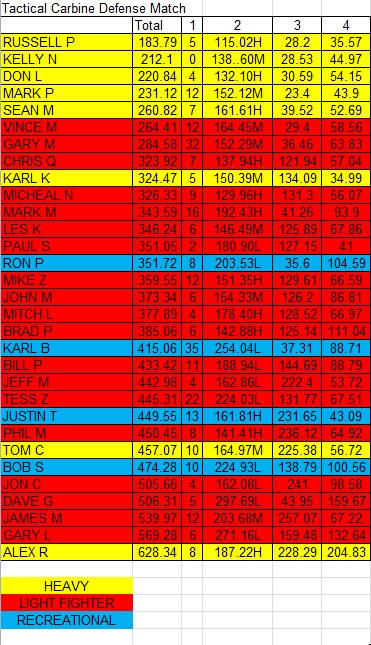
Phoenix Rod and Gun’s January Tactical Carbine defense match was a test of physical fitness and accurate shooting under stress. The stages put more emphasis on accuracy than typically seen at action shooting competitions with increasing amounts of time added based on the scoring zones hit. Stage 3 featured a V-TAC Triple Threat drill, with a 100 second penalty if any shots were outside the scored zones.
I placed 1st/8 In Heavy Division (hard armor plates required) and 1st/31 over all. Having the fastest time running and carrying the 70 pound kettle bell on stage 2 and shooting stage 3 clean is what allowed me to win the match.
Some general observations from the match were as follows.
1) Physical challenges defeat people mentally before they even attempt them. There was a lot of talk before the kettle bell stage about how hard it was. I knew it wasn’t going to be pleasant, but I knew it was something I could do, and that I could be uncomfortable for 2 minutes while going as fast as I could and still shoot well. I think many people went slower than they could have gone because they just didn’t like what they were doing or decided it was too hard before they started. A moderate exercise routine and knowing what you are capable of for how long go along way on these type of stages.
2) Knowing where your rifle and pistol hit at different ranges is critical for accurate shooting. People need to shoot at various ranges to become comfortable with their equipment at those distances. A lot of dropped points and the 100 second penalties were caused by this.
3) When accuracy is more important slow down and make the hits count. With a 100 second penalty on the line, there is no other option but to treat every shot as a critical hostage rescue shot, get a clean sight picture every time. Only go as fast as you are sure you can make the hit when the consequences are so severe.
Posted inCompetitions|Comments Off on 1-8-2012 Tactical Carbine Defense Match
The American Confederation of Tactical Shooters is a relatively young competition shooting organization having existed only since 2005 and only having 3 chapters currently. The focus of ACTS is to test practical shooting skills with rifle and pistol in scenarios representing civilian self defense, law enforcement, or military engagements.
I am fortunate to live close enough to attend the Arizona chapter based in Tucson, and have been participating there since 2007. I’ve been competing in action shooting sports since 2002, primarily 3 gun, and ACTS is very different from that genre of competitive shooting. The more main stream 3 Gun has become, the more routine, watered down and game centric it has become. I very rarely encounter a stage that makes me think “Can I actually do this?” in 3 Gun vs “How fast can I do this” anymore. ACTS regularly pushes the envelope through physical challenges, awkward shooting positions, and highly technical shooting. ACTS regularly faces the shooter with problems that make them question if they can actually accomplish the stage.
The difference between ACTS and other multigun competitions was emphasized greatly at the December 2011 match in Tucson.
Stage 1 required the shooter to wear a heavy pack and sprint back and forth between positions while using rifle and pistol. Any missed shot was plus 10 seconds to the shooter’s score.
Stage 2 involved shooting upside down and crawling out of an obstacle representing an over turned vehicle. In the linked video you can see the shooter handles his gun aggressively, throwing it clear (which would likely result in a dropped gun DQ anywhere else, even though its not inherently unsafe). ACTS is hard on equipment, and I don’t recommend bringing any guns or gear you want to maintain show room quality finish on.
Stage 3 had a 20 second par time for the shooter to engage 6 targets and get out through a hole in a prop. Short par times are often used to force shooters to move faster and increase the urgency in completing the stage. (unfortunately this was the only video of myself from the December 2011 match, I had camera issues. I placed 1st/14 Enhanced, 2nd/39 overall)
Stage 4 required the shooter to engage a pistol target at 50 yards and a rifle target at 100 yards crawling back and forth through a tunnel in the dirt every 5 hits with each gun. ACTS Stages often get competitors and their gear dirty; carpet or other ground cover to make it more comfortable for the shooter is a rare occurrence.
Physical challenges combined with hard technical shooting is the next evolution of the practical shooting sports. Physical fitness plays a key role in self defense or combat. Correspondingly ACTS has higher participation than other competiton venues of active or reserve military, law enforcement personnel, and recently out of the service veterans who enjoy the challenge and want to keep their skills sharp. Likewise self defense oriented citizens, and students of tactical training schools are likely to find ACTS more interesting and relevant to their interests than other multigun competitions.
I’m not dismissing 3-gun or multigun as not useful or not fun; it certainly can be and is probably a better place for shooters without a lot of experience or skill to start. There is however a demand for the type of competition ACTS offers. Whether people want to run clubs under the ACTS umbrella or start their own matches, the time has come for the action shooting sports to progress forward into this area.
Posted inCompetitions|Comments Off on ACTS: Not like any other Action Shooting Sport
Moving to fill the market demand for rifle/pistol matches Phoenix Rod and Gun Club is running a new format of Carbine match. Divisions are based upon the equipment shooters wear rather than the accessories on their guns. This may seem counter-intuitive if you are used to the way most other matches are run, but the CQB nature of the match reduces or eliminates any equipment based advantages. The physical nature of the stages also makes what a shooter chooses to wear to compete more of a distinguishing factor.
Heavy Weight Division:
Plate carrier with plates & soft armor panels.
Chest rigs, tac vest, Battle/duty belt , CCW and/or drop holsters.
No armor requirement , soft armor (no plates) optional
Chest rigs, Tac-Vests, etc and/or
Batt belts,CCW & drop holsters permitted.
sling mandatory for transition stages.
pack optional
Note: Heavy/LF div; weapon mounted lights for both rifle/pistol are optional and encouraged.
Recreational division
no armor or tactical gear requirement
common three gun/sport gear permitted
No pistol or sling requirement
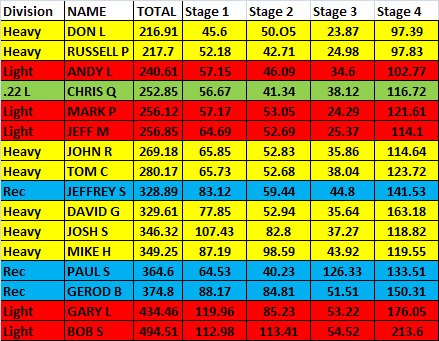
Results, I was 2nd place Heavy, 2nd place over all.
The scored drills format is definitely a good skills tune up vs elaborate stage designs. If the format continues like this it will give competitors a good gauge of their skills month to month, even if the stages/drills aren’t the same.
I also liked having a division where armor is required, I don’t feel like I’m sabotaging my score by shooting with it on this way.
Posted inCompetitions|Comments Off on Phoenix Rod and Gun Tactical Carbine Match
I’ve carried the same Glock 34 daily for 5 years now. Some of that time was in an outside the waist band holster, but for the past couple years I have been carrying inside the waistband (IWB) with a Raven Concealment Systems holster. Carrying IWB made it easier to conceal with less printing, but there is always a cost when advantage is gained in another area. The down side I found to carrying IWB was that through the summer months in Arizona my Glock came into a lot more contact with sweat.
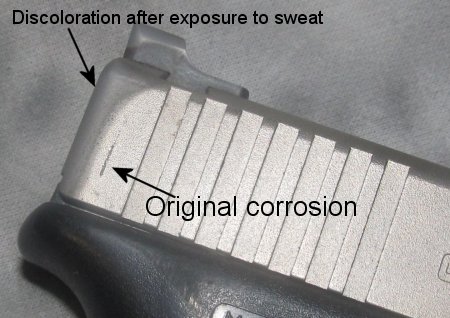
Regular cleaning and wiping it down with oil at the end of the day did little to prevent finish loss, and once the finish was gone it started to corrode. The worst of the finish loss and corrosion was on the back right side of the slide and at the right sight of the muzzle. Sweat tended to collect in the bottom of the holster and between the slide and the guard that keeps the pistol from digging into the side of the wearer (I’m left handed so the right side of the Glock is next to my body). Guns are merely tools to me, so while I do my best to keep them in good repair, finish wear doesn’t bother me. When it got to the corrosion stage I knew it was time to do something about it because rust was forming on a daily basis and it appeared to start spreading rapidly.
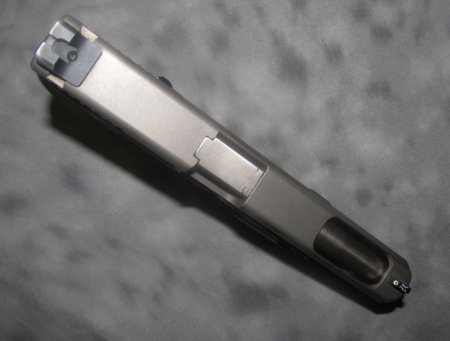
Fortunately, a friend of mine is a manager at Shooter’s World, and had recently received a flier for WMD Guns refinishing service. WMD offers Nickel Boron Plating for a variety of firearms components, including semiautomatic pistol slides and barrels. Nickel Boron coating offers improved corrosion and wear resistance over traditional firearms finishes. It sounded like just what I needed to have done to refinish my Glock, so I had Shooter’s World send it off my barrel and slide and they came back about 4 weeks later.
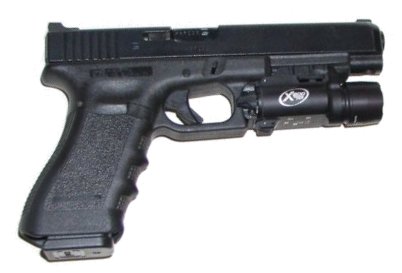
Here is the end result:
I’ve been carrying it for 4 months now, and 2.5 of that was in 100+ temps so it did get sweaty in the same manner as it did before. The finish does not appear to be going away in those areas, and it shows no sign of further corrosion, but it is discolored:
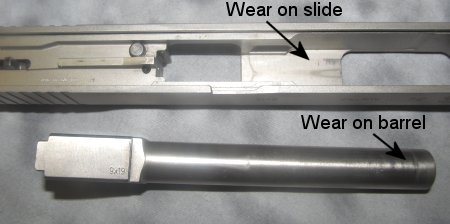
I’ve also fired 500 rounds through it since getting it back. The finish on the barrel and slide shows wear as one would expect from firing:
All the wear from firing seems very normal. Cleaning is much faster and easier with Nickel Boron coating as carbon does not stick to it the same way. Even the worn areas do not retain carbon fouling as a traditional finish would.
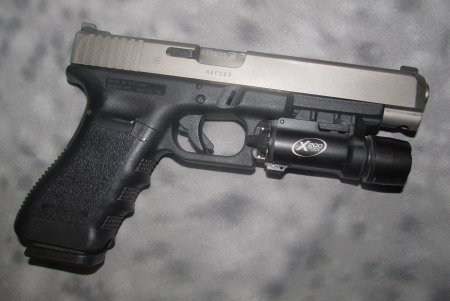
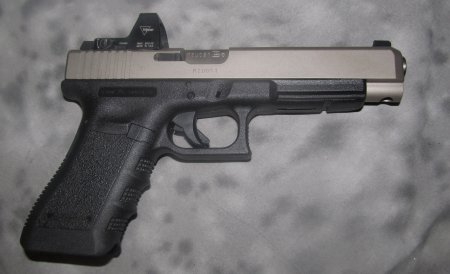
Nickel Boron plating is a worthwhile upgrade to any gun that is going to be carried and used. The corrosion resistance makes it particularly useful in hot or humid climates. In addition to being functional it also looks great. I liked it enough that I got my Glock 34 with RMR coated as well:
If you live in the metro Phoenix area, Shooters World can help you get your gun refinished, or send it off for you if you are purchasing new. If you live elsewhere, you can send your components in direct to WMD Guns, or talk to your local dealer about getting a batch together to send in.
Posted inGear|Comments Off on Nickel Boron Plating of my Glock 34
The 3rd annual Halloween Shotgun match was hosted by the Pima Pistol Club ACTS division on October 30th, 2011. As the name implies, it is a shotgun only action shooting match. Competitors were placed in the following divisions based upon the shotguns they used:
Boomstick: Any double barrel or single shot break action shotgun
Action Hero: Pistol grip only pump action shotgun. Sidefolder ok if remains folded. Lasers and Optics allowed
Pump: Pump Action with 9 shot capacity and Iron sights
Auto: Semi auto with 9 shot capacity and Iron sights
Only birdshot is required for this match, no buck or slugs are needed or allowed.
The stages are always based around horror movies, books, or games, this year the stages were as follows:
Stage 1: The Ring
PREMISE: You’ve rented a video from The Warehouse and settled in to relax in you Lay-Z-Boy. Oddly, a crazy bitch with long black hair comes out of your Magnavox to ruin your evening. Luckily, you always watch movies with a shotgun in your lap…
SETUP: The shooter will start seated in the chair. His shotgun will be held safely in his lap, with no more than 2 rounds loaded in the magazine. His CHAMBER WILL BE EMPTY, and the action may be opened or closed. The tape will be in the VCR.
PROCEDURE: At the buzzer, the shooter will remain seated and neutralize the 6 targets directly in front of him. The shooter will take the tape from the VCR, stowing it as he sees fit, go to Box 1, and neutralize the two targets. He will then move to Box 2 and neutralize the two targets. Finally the shooter will move to the “well,” put the tape in the well (not throw it) and neutralize the triple-dropper from behind the well. Time ends when the triple dropper falls.
Stage 2: Where the hell is Elm Street
PREMISE: These nightmares keep getting worse. The first one wasn’t bad, you were eating at the Golden Corral and only got slightly sick. However, a month later, you’re being chased by some freak with knives for fingers. This sucks. You’re going to kill him.
SETUP: The shooter will begin in the Start box, shotgun fully-loaded to division’s capacity, held at low ready. The shooter will signify ready by hitting the “snooze” button on the provided alarm clock on the table.
PROCEDURE: At the buzzer, the shooter will engage the appropriate targets from the start box, move to Box 1, repeat, and move to box 2 and repeat. Time will end when the shooter closes “Freddy’s head” completely shut.
Stage 3: The Thing
PREMISE: During your yearly vacation to Antarctica, your dog’s chest and husband’s arms suddenly rupture open with tentacles. WTF?
SETUP: The shooter will choose to start at A, Ab, or O+. Her shotgun will be loaded to capacity and held at low-ready.
PROCEDURE: At the buzzer, the shooter will neutralize TWO steel targets from her start position, and then move to the next position. At the next position, she will neutralize TWO targets, and then move to the next position. She will continue to move between positions, neutralizing only two targets at a time until all steel has fallen.
THE BLACK STEEL TARGETS ARE NO-SHOOTS. IF THEY ARE NEUTRALIZED, IT WILL BE A 10 SECOND PENALTY.
Stage 4 Halloween
PREMISE: It’s Halloween. Some guy wearing an all white William Shatner mask kept ringing your doorbell trick-or-treating, but he was way too old for this nonsense. You slammed the door in his face. It is now 3 hours later, you’re the last survivor in your house, and you need to get away from this guy. He must be on Angel Dust or something: he seems unstoppable.
SETUP: The shooter begins in the hallway, his shotgun loaded to division capacity, and held at the low-ready.
PROCEDURE: At the buzzer, the shooter will neutralize the falling plate and 2 pepper poppers. If the plate does not fall after 4 hits, it is considered neutralized. The shooter will then move to the first barrel and neutralize the falling plate and the two poppers. If the plate does not fall after 4 hits, it is considered neutralized. The shooter will then move to the last barrel neutralize the 4 poppers and get 4 hits on the big steel.
Video of myself shooting all 4 stages
I placed 3rd over all/51, 3/11 in open.
The Halloween Shotgun match also always features a 4 man team shoot off with a massive array of steel. This year teams could only have one Open and one Auto shooter.
Second Place Team Video:
Of course the most fun part of the Halloween match is the costumes.
My girlfriend, Stephanie, and I went as Monster Control Bureau Agents from Larry Correia’s Monster Hunter Internaional novels:
The Monster Hunter International book series by Larry Correia is a favorite of mine. The basic premise of the story is that all the various monsters and magical creatures from fiction really do exist and the government pays private military companies bounties for killing them. The story follows a character that happens to be a successful 3 Gun Competitor as he moves into the world of professional monster hunting. All three books in the series have been very fun to read. Its as if you are reading an action movie because the pace rarely slows down. Firearms enthusiasts and gun culture people will especially appreciate Larry’s novels; Larry is a gun guy himself having formerly run a gun shop, participated in the action shooting sports, and instructed firearms classes. The detail and accuracy of the way firearms are portrayed in his novels is a rare treat for gun people to read.
Larry is currently working on the fourth novel in the series, and it begins at the monster hunter equivalent of SHOT Show. As such, more MHI teams, government agencies, and private military companies are to be featured in it. Larry posted a design a patch contest last month, and voting is now open. The winner gets a mention in the next novel.
Here is my submission for a private monster hunting company:







You must be logged in to post a comment.