In October of 2009 a debate was raging on one of the local shooting forums as to how reliable AR15s could be when exposed to dirt and debris in desert environments. I have always believed that AR15s are more reliable and can deal with more fouling than they are given credit for as long as they are well maintained. I decided to make these videos at the time to show that the AR15 type rifle is more capable of operating in adverse conditions than it is given credit for.
The rifle I used was a CAV-15 MKII lower with CMMG 5.56mm NATO lightweight upper. This is one of the cheapest rifles someone could possibly build. At the time this rifle would cost less than $600 retail.
This is the first test:
The rifle worked flawlessly for the entire test
One of the immediate criticisms I received was that the test should be done with the dust cover open. I made a second video doing exactly that:
The rifle was NOT cleaned between tests, and again it worked flawlessly.
I would not expect the rifle to work with this level of abuse day after day, particularly without cleaning and without regular armorer level maintenance. There are a number of small parts on AR15 that need to be replaced on a regular maintenance schedule based on the number of rounds fired; the longer parts are used past their intended service life the less reliable the rifle will be. Magazines needs to be cleaned regularly, and replaced as well.
I received a lot of hate mail at the time for making these videos, and still do receive some occasionally. The videos speak for themselves, properly manufactured and maintained AR15s can work in adverse conditions. “Haters gonna hate” as they say.
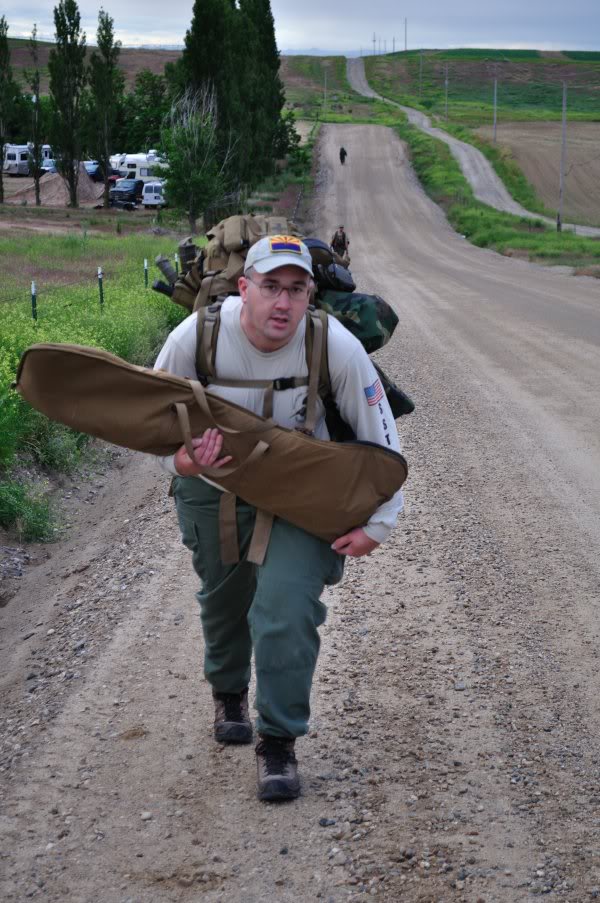
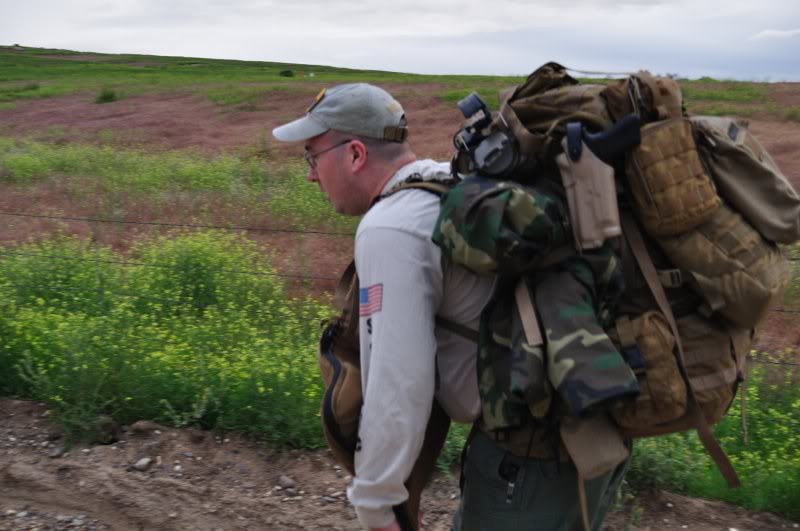
June 10th-12th, 2010 I competed in the Ironman 3 Gun Match in Parma Idaho. The Ironman 3 Gun is unlike most other competitions in that it has a round count roughly 3 times normal matches, and it is physically demanding with stages requiring shooters to sprint up to several hundred yards and carry heavy things. To make it even more difficult, I compete in Trooper class; where we are required to carry all of our gear from the start of the match to the end of the match stage to stage and we cannot resupply anything outside of what we store in a standard ammo can size at the Trooper Gear Check Point. Equipment is completely unlimited; competitors can use any gear they want as long as they can carry it.
Doing the long hike up the hill to Stage 10:
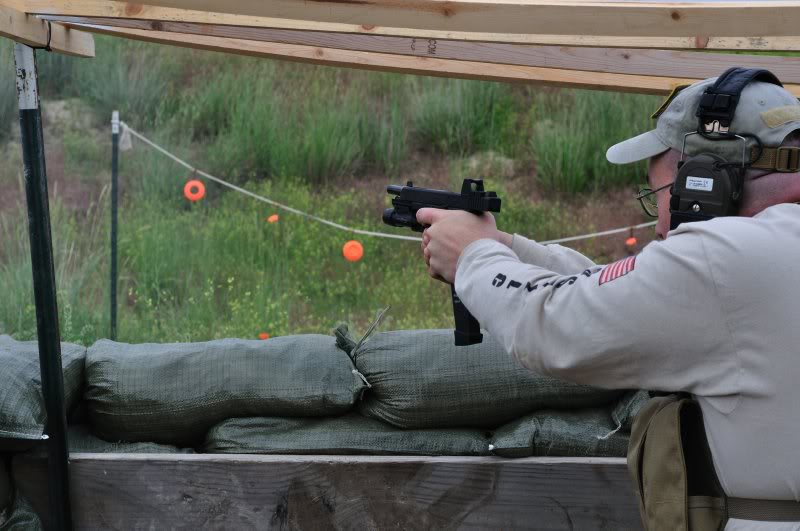
This was also the first major match I used my OST-TSD modified Glock 34
In my modified Safariland Holster:
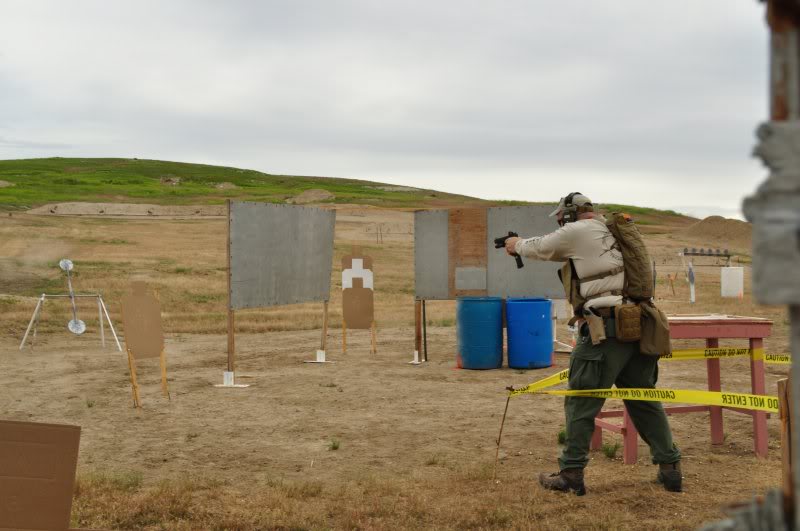
Some action shots:
I do believe the RMR equipped Glock made much of the pistol shooting easier for a several reasons:
1) Simpler sight picture: The dot was much easier to use on small and moving targets than traditional sights. Putting the dot on the target was easier than alligning sights and tracking moving targets. It really made targets like the double spinner (the shooter must rotate it 360 with correctly timed hits) easier to engage.
2) Knowing when not to pull the trigger: The dot may be bouncing around a lot after sprinting a couple hundred yards, but it gives you more information on your stability to make a shot than traditional sights where the movement is not as obvious.
3) Speed increase using the RMR equipped glock was the net effect increased accuracy: I needed fewer shots to successfully engage all the targets.
The one downside to having the RMR equipped Glock was that the lens accumulated sand simply being in my holster. Parma, ID has very fine talcum powder sand and there were high winds all 3 days of the match. It never accumulated enough sand to be unusable, but it was enough to reduce effectiveness. Fortunately I was able to blow the sight off and use a lens wipe before every stage. Even covering the pistol in the holster with a spec ops brand recon wrap allowed sand to accumulate. I think a purpose built field/duty style holster would need to completely cover the rear of the sight.
I ended up 3rd place in Trooper this year out of 24 competitors.
In total Time: Chuck Anderson 1989.61 Iain Harrison 2022.47 Russell Phagan 2120.21
In Match Points: Chuck Anderson 845.42 Iain Harrison 800.15 Russell Phagan 768.25
The main thing that caused me grief this year was intermittent feeding issues with my Saiga-12 costing me at least 100 seconds in penalties from missed flying clays (10 clays at 10 seconds each). But that’s another story.
I consider this first major test of my RMR equipped Glock a success.
The American Confederation of Tactical Shooters Arizona division hosts monthly Rifle/Pistol Matches at the Pima Pistol Club on the 3rd Saturday of every month.
ACTS distinguishes itself from traditional action shooting sports in stage design. The stages often incorporate physical challenges, awkward shooting positions, support side shooting, strong hand only shooting, and other elements that make it generally more challenging than traditional multi-gun shooting.
ACTS is one of the few venues where equipment really doesn’t matter. People have won the match before with equipment as simple as Mini-14s and AK with Iron Sights. In general I think running a red dot sight at ACTS is a distinct advantage given all the awkward firing positions. Optics with magnification and limited eye relief are something I would generally view as a disadvantage for ACTS. You will encounter limitations with equipment at ACTS matches that will not be found in traditional 3-Gun/Multi-gun.
The unique stages ACTS offers has resulted in ever increasing match attendance drawing in participants who are traditional action shooting competitors, students of tactical training schools, and military and law enforcement personnel.
2-19-2011 ACTS Tucson AZ
1st Place Overall and 1st Place Enhanced this month out of 40 shooters.
This month’s match gave the shooter choices on every stage. Generally they were between a physical challenge with easier shooting, or no physical challenge and more difficult shooting. I picked the physical challenges; my strategy + ongoing physical fitness routine paid off.
3-19-2011 ACTS Match Tucson, AZ.
2nd/46 overall. 1st Enhanced Division.
This month’s match was all support side shooting. I’m naturally a left handed shooter, so I shot all right handed.
4-16-2011 ACTS Match Tucson, AZ
1st place Open, and 1st/58 shooters over all this month
My rifle is a CMMG 14.5″ Midlength upper with permanent flash hider, Aimpoint T-1 Micro and Cav-Mfg furniture.
My pistol is a Glock 34 with Trijicon RMR installed by One Source Tactical
Posted inCompetitions|Comments Off on ACTS February-April 2011
I had Coyote Tactical make this vest to my specifications back in January of this year
It may be over kill for most matches, but if you’re going to be a tube-fed Ironman Trooper its probably just enough.
Its purpose built for carrying the California Comp Works carriers. The CCW carriers are the UM84 style; there is a 2.75″ section of rigid nylon underneath for them to attach to. They are easily removable if I’m not using a shotgun. The vest has two duty keepers that tie into my pants belt and duty belt the prevent it from riding up when ripping out the shells. The suspension system is an H-harness style to distribute weight better and avoid pinching the back of the neck.
The AR mag pouches are kydex lined to retain the mags. They work with PMAGs or USGI.
The mag carriers and shell carriers are offset to the right because I am left handed (reload with right hand)
The left side of the vest has a removable pouch for first aid supplies available through Cavalry Manufacturing
Posted inGear|Comments Off on Coyote Tactical 3-Gun Vest
The Tiger Valley Tactical Team Match is something unlike any other match open to the public. Competitors work in groups of 4 to solve practical shooting and physical challenges and are graded on speed and accuracy. The stages are set up in such a way that all shooting is done from designated areas, pistols are holstered between shooting zones, and long guns are cleared, thus making it safe for anyone with basic gun handling skills to attend.
This was the 3rd annual match. Shooters who come to Tiger Valley need to be prepared to compete in all weather conditions. The 2009 match was held in June with brutal heat and humidity. The 2010 match was held in high winds, rain, and 40 degrees. The weather for the match this year was ideal; high 80s with relatively low humidity. This made the match more pleasant and no doubt helped it run more efficiently than in years past.
Scoring on the stages was generally time + penalties added in the form of time. Steel could be shot at as many times as necessary to be neutralized, paper targets generally had limited numbers of rounds allowed and only A-zones counted for score.
There are no equipment divisions. The only gun equipment prohibited is red dots on pistols; probably because holsters with retention are necessary here. Teams generally ran rifles that would commonly be found in tac-scope 3 gun division, with bipods added as necessary for some stages. Teams were required to use the same firearms for the duration of the event. Equipment that was to be used on any stage had to be carried on all stages; this included straps, ladders, packs or anything else a team might need to use to complete the challenges.
Day 1
Stage 1
This was the only stage in which shotguns were used. Not everyone needed to use shotguns, it was up to the team to decide how many it wanted to use.
This stage consisted of 5 bays
1. Designated marksman engages suicide bomber tannerite target. The rest of the team moves to cover under fire of remote control paintball gun. Once the DM takes out the bomber, the paintball gun shuts off
2. Shotgun targets
3. Pistol plate racks
4. Shotgun targets
5. Rifle targets at 125 yards. They had to be shot from a prescribed position found on a corresponding stick in front of the engagement area. Standing, kneeling, sitting, or prone
Stage 2:
Obstacle Course/Fire and Movement.
• The team begins on the chopper. Designated marksman engages 3 half torso targets at 200 yards with one hit each. Once neutralized the team starts moving through obstacles
• The team cannot start an obstacle until a shooter begins engaging a paper target at 100 yards from each position. The targets could only be engaged 10 times, only A zones counted for score.
• Obstacles included 8 foot tall sniper tower, window, ramp, 6 foot wall, 8 foot wall.
• At the end was a bunker with steel targets at 200 yards. Two shooters went into the bunker to engage these targets.
Stage 3:
Retreat
1. The team began in front of 8 steel pistol target that had to be hit with one round each; effectively each member shot 2 targets.
2. They then fell back to the 100 yard line and shot 10 rounds for score on a paper target
3. They then fell back to the 200 yard line and shot 10 rounds for score on a paper target
4. They then fell back to the 300 yard line and shot 10 rounds for score on a paper target
5. They then fell back to the 400 yard line and shot 10 rounds for score on a paper target
All movement was done on the clock, winds were pretty strong making the 300 and 400 yards shots difficult. Only A-zones counted for score.
Stage 4
From the second story of a sniper tower, the team had to engage 4 targets, with one at 50 yards, 100 yards, 150 yards, and 200 yards. Each team member picked one target and shot it from one of 6 positions through holes in the wall with 5 rounds from each position. Only A zone hits counted on the paper, and you could not move to the next port until the team member in front of you had moved.
Stage 5
Teams began at the bottom of the 60 foot tall tower. One at a time they engaged 2 x5 pistol steel, then moved underneath the tower to engage 8 more pistol steel, then went to the top with rifles to shoot 2 LaRue targets each.
Day 2
Stage 6
Teams began at the bottom of the 60 foot tall tower. One shooter engaged 2 x5 pistol steel, one immediately moved underneath the tower to engage 8 pistol steel, two immediately went to the top carrying 30 pound fire hoses.
At the top there were four USPSA targets straight down at the base of the tower. They could only be shot 10 times, only A Zones counted for hits.
There were then 4 LaRues at varying distances that each team mate had to shoot one of.
Stage 7: Get to the chopper!
This was like stage 2 in reverse. The catch this time was the team had to carry a dummy in a stokes basket over obstacles rather than going over obstacles themselves.
• Two team mates began in the bunkers shooting down a bunch of steel plates in a simulated building again
• Two other team mates immediately began moving through the low crawl
• At each obstacle a shooter had to knock down a LaRue at 200 yards.
• Obstacles included 4 foot wall, 6 foot wall, ramp, and window.
• At the end the team loaded the basket into the chopper, hopped on the skids and designated marksman engaged 3 half torso targets at 200 yards with one hit each.
Stage 8: The Trench
This was a semi blind stage with a number of USPSA targets that required one A-zone or two hits anywhere to be neutralized. The shooter sprinted 50 yards into the trench then scanned for targets while moving through it. This was run individually, only the faster shooter’s score counted I would estimate about 175 yards of movement total on this stage.
Results:
10 teams showed up to compete. While not as high as the match organizers had hoped, it seemed ideal from as the match ran on time with no delays and there was just enough down time between stages to catch your breath and load magazines.
Dallas SWAT Dominated the match winning 7/8 stages and getting 785 out of 800 match points.
The second place team was also an LE team with 611 match points.
3rd place was team CAV-MFG with 607 match points (so close!). We won the one stage that was purely rifle shooting out to 200 yards with awkward positions.
This was the best Tiger Valley Team match yet, TJ has put some effort into improving the stage designs and making the match run better logistically. The stages generally allowed for more free thinking problem solving than years past and to some degree teams could assign members to different tasks to optimize performance. There still were some points where the team could be limited by the slowest runner or slowest shooter, but much less than before.
The Tiger Valley Tactical Team match is truly the next level in competitive shooting. Combing physical strength, endurance, and agility with team work and shooting creates a better more interesting type of challenge than traditional action shooting sports with a wider set of skills to practice and master. The worst part about the match is that I have to wait until next year to do it again.
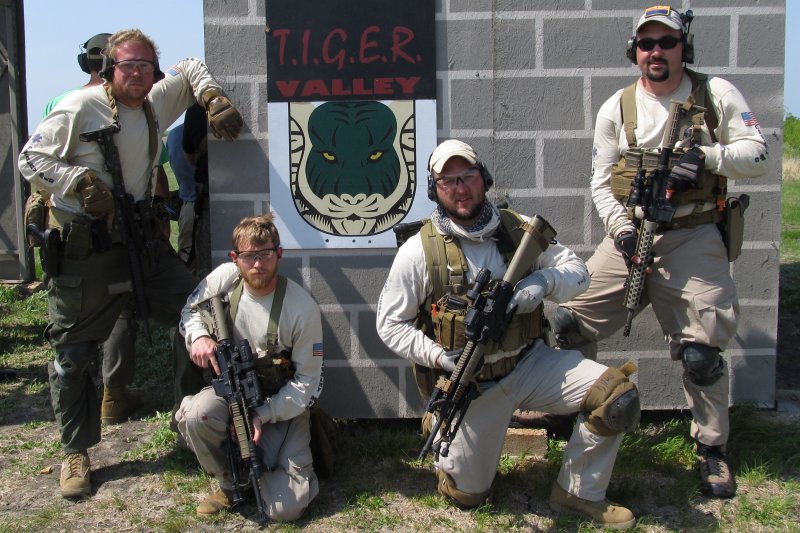
Team CAV-MFG (left to right): Karl (CeramicGod), Matt (Killswitch), Brad (Berd), Russell (SinistralRifleman)
The 60 foot tower looms in the background at Tiger Valley.
I decided to start a blog to have a centralized location for all the competition, training, and match reviews I’ve normally posted on forums over the years. I will be reposting some old ones, and adding new ones as I write them.
Posted inUncategorized|Comments Off on Welcome to my internet!





 SinistralRifleman
You must be logged in to post a comment.