The number of AR15 Back Up Iron Sights on the market has exploded over the past 10 years. I’ve had the opportunity to try a number of different models over the years. The problem with many of the designs on the market is they are too large, too complicated, and interfere with ideal mounting or the operation of the primary optics sighting systems on the rifle.
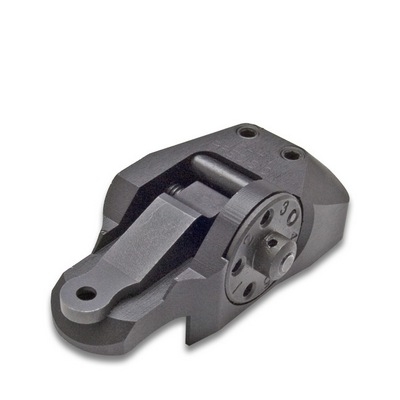
The Hahn Precision BUIS addresses all these concerns with a compact, functional, rugged design.
The body of the sight is machined from Aluminum billet and hard coat anodized. The aperture/sight tower is made from wire EDM’ed steel. The aperture diameter is 0.100″ and allows the shooter a good compromise between long range accuracy and close range speed. The aperture/sight tower is held folded and held up by spring tension. Deploying and stowing the sight is simple, there are no buttons to push or levers to fold out of the way, simply push the sight up or down. While the sight does not snap into place under its own power, it will not fold under recoil. If dropped on the sight it will fold to prevent damage.
The Hahn Precision BUIS is very low profile and fits underneath magnified optics, and only uses the rear most slot on a flat top upper receiver. It is also low profile in width by making use of the A1 style adjustment system. The sight stays zeroed unless deliberately moved. Another advantage to the A1 style adjustment system is there is not a large windage knob interfere with charging handle operation. Shooters with flip to the side magnifiers for red dots will particularly appreciate this. With the magnifier flipped to the side access to the charging handle can be much tighter with a large windage drum in the way, with the hahn sight the shooter can operate the charging handle normally. This feature alone is why I have gradually replaced all my BUIS with Hahn Precision units.
The Hahn Precision BUIS is a well thought out, quality manufactured unit and combines all the best features that a BUIS should have.
The June 2011 ACTS match was very accuracy centric with two of the stages being Virgina Count (you aren’t allowed more than the minimum rounds). There were also mini-IPSC steel targets used at range for the first time which are roughly half the size of a full size IPSC target.
I placed 2nd/47 shooters. Attendence was lower than the previous two months due to the heat. Match attendance always decreases in the summer in Arizona.
You will notice I’m shooting my standard Glock 34 with Warren Tactical/Sevigny Sights in this video. This was the first time shooting it after three months of continuous use of the Glock with Trijicon RMR. I don’t feel like I lost anything or my skills with iron sights degraded during that time. The fact the OST-TSD conversion puts back up iron sights in line with the red dot makes acquiring the sights on either configuration similar enough as to not matter when switching back to standard iron sights.
Posted inCompetitions|Comments Off on ACTS June 2011
From June 5th to 7th 2011 in Parma, Idaho I participated in the MGM Targets Ironman 3 Gun Match. The Ironman 3 Gun sets itself apart from other 3 gun matches in its high round count. The match requires 3-4 times as much ammunition as other major 3 Gun matches. It is a true test of not only the shooter’s skill, but also endurance and durability/reliability of their equipment.
This was the 10th consecutive Ironman 3 Gun I have attended. The match has grown a lot over that time. This year the match was split into two parts; Trooper, Open, Heavy Optics, and Limited shooters all competed June 5th-7th. Tac-Scope division shooters all competed from June 9th-11th. This was certainly the most logistically efficient and organized Ironman I’ve attended. We were done shooting by 6:30 the first two days, and scores/prizes were done rapidly the last day as well. I think a good balance has been struck between making stages longer and more challenging than most 3-gun matches, and still making it so everything runs on schedule.
Trooper Class
The Ironman 3 Gun is the only remaining major 3 Gun match to feature Trooper Class. It is also the only match where Trooper Class is a significant additional challenge. Trooper requires that the shooter carry all the gear, guns, and ammo they will use for the entire match from start to finish. Gear can be grounded when shooting a stage, but your guns better run or you better have the tools/parts to fix them, and you better have brought enough ammo. Running out of ammo or having guns break can result in getting bumped out of Trooper Class into whatever division your guns would put you in. The advantage to Trooper Class is that equipment is totally unlimited. It is in fact more “open” than Open in that shooters can use multiple guns, reconfigure them, and even use pistol caliber carbines instead of a pistol.
Trooper Class at Ironman has continued to grow every year since it was included in 2005. This year 29 Trooper Shooters registered for the match, and 26 finished. The level of competition in Trooper division has definitely been increased. I’m glad to see the division I helped create attract more shooters in general and more upper tier shooters. Congrats to Chuck Anderson on winning Trooper Class this year. Ben proved that it isn’t entirely an arms race in Trooper by finishing second with his Tac-Scope division gear. Iain Harrison (as seen on Top Shot season 1) finished third. Anyone who finishes in Trooper at Ironman can consider it an accomplishment regardless of placement.
I personally finished 5th/26 this time and I’m content with that given the skill of competitors that are now participating in the division. I shot to the best of my ability with minimal penalties (its almost impossible to shoot this match 100% clean) and all my equipment worked. My physical fitness was the best it has ever been for this match and I did not feel like it was a limiting factor during any of the stages. The issues I identified to get faster on these stages were ones of general stage efficiency/management, and I think being squadded with some of the upper level shooters in the future could help with that to be able to learn by watching them.
Guns, Equipment, and how it all worked.
Rifle
Primary: 16″ Sabre Defence Midlength with Trijicon TA31DOC, Primary Weapons FSC556, and Troy TRX Extreme Rail.
I used this rifle on eight of the ten stages. Most of the rifle shooting at Ironman is at 100-300 yards, with a few targets at 400 yards. The ACOG is a good optic to use within this operational criteria. I like cross hair reticle of the TA31DOC as it is more precise for dealing with skinny sammies than a donut or chevron reticle.
Secondary: 18″ Gamma Designs intermediate gas system upper with Aimpoint T1 Micro, Primary Weapons FSC 556, and Troy TRX Extreme Rail.
I carried this spare upper and used it on two of the ten stages that were close quarters only, and using an ACOG would have been a hindrance. The recoil impulse of the intermediate gas system is less, which made for faster more controlled double taps on paper.
I did not clean either upper during the match, and both ran without malfunctions for the duration.
Rifle Support Gear
Harris Bipod (swivel style) on Larue QD mount: I used this on only one stage. Every other stage with distance shots had barricades or some type of support to brace on.
Viking Tactics Sling on QD Mounts: There were several stages that required the use of a sling with the rifle. the V-tac is a good simple, easily adjustable sling, and the QD mounts let me take it off rapidly for the stages where I didn’t need it. If I’m not actually wearing a sling I prefer to not have it on the rifle.
Shotgun
Primary: Saiga-12 with Aimpint Comp M2 on K-VAR Mount, SGM Modified Choke, AGP Side Folder stock, Krebs Iron Sights, AGP magazines.
My Saiga-12 ran for the duration of the match with only 2 malfunctions. Both were failured to feed; the gun extracted and ejected, but the bolt went forward without picking up the next round. Simply racking the bolt solved the problem both times. This is the most reliable a Saiga-12 has ever been for me at Ironman. Shotguns are the most problematic gun for all competitors, and mine seemed to run better than most.
I did have trouble with accuracy with slugs at 70 yards on one stage. I will be trying different slug brands in the future to find a more accurate slug for my gun.
The side folding AGP stock is solid and comfortable, and allowed me to more easily strap the gun to the back of my pack. The AGP 10 round magazines performed reliably without issues.
The only maintenance performed on the Saiga was brushing out the gas system after the first day of the match, and cleaning out some of the magazines that had been dropped in the dirt.
Secondary: Benelli M2 24″ with Nordic Components extension and Williams Fire Sights. I brought this gun with an additional support gear in the event I encountered too many problems with my Saiga as I had before. I ended up not needing to use it as the Saiga stayed reliable enough throughout the whole match. I am very superstitious when it comes to preparing for Ironman, if I hadn’t brought the Benelli I am sure the Saiga would have failed spectacularly.
Pistol
Glock 34 with Trijicon RMR (LED illuminated) mounted on the slide, cowitnessing suppressor sights, and X200. The factory slide was modified by One Source Tactical’s Technical Services Division to mount the RMR.
I found the RMR glock to be particularly useful at the Ironman 3 Gun due to the number of precision pistol shots required at 25-30 yards. In the past I had used a pistol caliber carbine in Trooper division because of the accuracy advantage. Using the RMR equipped Glock has eliminated the need for me to do so by allowing me to make better use of my pistol skills. I still have to do my part in aiming and trigger control, but the red dot is easier to read on target for when to pull the trigger and when not to. On farther shots the dot being super imposed on the target rather than the target being covered by iron sights made it easier to shoot accurately.
Gear
My pistol belt is a Spec Ops Brand Gun Fighter belt with Spec Ops Brand suspenders. The Gun Fighter belt is nice because the closure system allows for rapid resizing over heavy clothing or after a heavy meal. The SOB suspenders are soft elastic material that are comfortable throughout the day, and the X style design prevents them from sliding off my shoulders like H style suspenders have in the past.
I have gone away from thigh rigs as I feel they reduce my mobility. My holster is a belt mounted Safariland 6280 modified to accept the Glock with RMR. I have two pistol magazines, one rifle magazine, and a dump pouch on my belt. I also have a utility pouch for batteries, lens wipes and misc items.
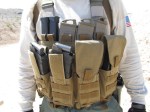
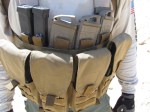
My vest is the Coyote Tactical Trooper Vest specifically designed for use at Ironman. It carries 4 Saiga mags, 3 AR15 mags, and 2 Glock 30 rounders. It was comfortable throughout the match and allowed me to carry my stage minimum + 50% load out on every stage. The amount of movement on the stages made me make use of the retention flaps most of the time to keep the Saiga mags in place; this made my reloads slower but I never lost any mags on a stage. I heard of at least one other shooter with a more speedy set up losing all of his mags during a stage, fortunately he had more prepositioned to use down range. This is a good example of how getting past a certain speed level involves more risk, shooters need to decide for themselves what level of risk they are willing to accept based upon their goals in attending a match.
My pack was a Kifaru EMR with a number of pouches and accessories added. I’ve used this pack for several years now because it allows me a lot of storage space, and the rigid frame and padded belt make it more comfortable to use.
My total load out between pistol belt, vest, pack, guns, and ammo for the match weighed in at 140 pounds at the start. This got lighter with every staged fired. I started the match with 800 rifle, 800 pistol, 400 shot, and 145 slugs between what was on me and what was in the ammo can cache at the Trooper check point. I only used about 60% of that total, I can probably safely trim that down for next year. Shooters with lesser pistol skills or long range rifle skills should consider a 3:1 ratio in ammo packing. Bring three rounds for every one shot required. Pistol is easiest to run out of. Conversely the round count for shotgun is usually closest to the number of rounds you will actually use.
Videos
I was fortunate to get POV video of all the stages this year. I use a Vio POV 1. I really like this set up because it is rugged, weather proof, and easy to calibrate and review footage immediately. Here are all the stages in the order I shot them:
Stage 10
Stage 1
Stage 2
Stage 3
Stage 4:
Stage 5:
Stage 6:
Stage 7:
Stage 8:
Stage 9:
In closing, I recommend that all serious competitors try the Ironman 3 Gun at least once. If I had to pick one big 3 gun match to go to once a year it would be the Ironman. For the same amount of time off work, travel, and match fee you get 3-4 times as much shooting as any other major match. The Ironman gives me something to work towards throughout the year and I view it as an annual test of my shooting skills, physical capabilities, and the reliability and effectiveness of my equipment. You will learn things participating in this match that you will not from any other 3 Gun Venue.
I shot all the local Arizona matches this month using all the guns and gear I will be using for the MGM Targets Ironman 3 Gun June 5th-7th. Whenever you are training up for a major match it is important to use all the guns and gear you will be using for that match leading up to it. Everything has to work together as a system, not just as individual components.
If you only use things individually, you will not find the potential problems or conflicts it might have when using it all together. Does your vest block access to pouches on your belt or hinder your draw from the holster? Are the straps uncomfortable when worn all day long? Does the buttstock of your long gun not seat properly when you’re wearing a vest? You will never learn these things if you don’t use it as a total system.
I wore my Saiga shotgun mags at the ACTS match where no shotgun is required. After low crawling through the dirt I found the shells in the center two pouches were totally jammed up from dirt/debris. I’m glad I learned this at a match where I didn’t even need to use the shotgun rather than in the middle of a stage at Ironman (there has been low crawling portions before). Now I know to carry them shells down if I encounter a stage with low crawling; a slower reload with a working mag beats malfunctioning mags. I could also stage ammo down range if that’s an option for a particular course of fire. I have mag cleaning brushes for my rifle and pistol magazines I keep in my range bag, but nothing for cleaning the big Saiga-12 mags. The best option I found shopping for something to clean out my Saiga mags was a small nylon toilet brush-LOL.
Match videos and results for May 2011
Rio Salado Multigun 5-14-2011 13th/62 over all
Phoenix Rod and Gun 3 Gun 1st Open division
Rifle: Sabre Defence 16″ midlength with Trijicon TA-31DOC, Troy TRX Extreme rail, and CAV-MFG C2 stock.
Shotgun: Saiga-12 with AGP side folder, Aimpoint Comp M2 on KVAR mount, SGM Modified Choke, Krebs Iron Sights. AGP mags
Pistol: Glock 34 with Trijicon RMR and X200.
Vest: Trooper vest by Coyote Tactical
ACTS 5-21-2011 2nd/55 over all. 1st Open division
Rifle:
Gamma Designs 18″ intermediate gas system 3 Gun barrel
Aimpoint T1 Micro
Troy TRX Extreme Rail
CAV-MFG C2 stock
I’ll be bringing this upper with me to Ironman to use on close range stages and for back up; Trooper division allows me to reconfigure my guns as I see fit with anything I am carrying. I will be reviewing the Maxey Systems 3 Gun barrel in an upcoming blog.
Posted inCompetitions|Comments Off on May 2011 Matches
In the spring of 2010 I had One Source Tactical’s Technical Services Division modify the slide on one of my Glock 34s to accomodate a Trijicon RMR. The turn around time was fast and the work well done. The OST-TSD modification is unique in that it allows iron sights to co-witness through the optic. The ability for the irons to co-witness is what made the system appealing to me. Training to use a dot on a pistol is much harder than on a long gun. On a long gun the stock naturally puts the shooters eye in the correct location to see the dot with cheek weld. On a pistol, if it is not presented correctly, there is no natural index point and the shooter can struggle to find the dot. The co-witnessed irons allow the shooter to more naturally pick up the dot on the draw when transitioning from traditional sighting systems. They’re also handy to have in case the battery/sight dies (something I haven’t had happen in 1 year of use).
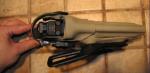
Once I had the pistol back together, the trickier part was getting a holster to fit my needs. I’ve been using the 6000 series Safariland holsters since 2003 for 3 gun competition. I’ve always liked the added security of the rotohood and I don’t feel it has ever slowed my draw down. As there is no dedicated holster with retention on the market for the Glock with RMR, and I am used to the system I decided to modify one of the holsters I had already.
I assume a lot of other people are running 6000 series Safariland holsters and might want to see how to go about doing this.
You will need the following
Heat gun
epoxy
4″x4″ square of kydex
Gloves to work the hot kydex with
hack saw blade.
Step 1: Cut down on both sides of the front of the holster about 2″ with the hacksaw blade. Do not remove the piece left standing in the middle.
Step 2: Use the heat gun to warm up the kydex piece in the center and bend it out away from the holster.
Step 3: Insert your Glock and make sure it goes into the holster all the way and there is no interference with the sight. If it does have interference cut/bend further.
Step 4: Without the glock in place get the kydex piece heated back up. Then put the glock back in and form it around the RMR.
Step 5: Use hacksaw blade to cut the kydex piece off above the RMR body. Verify that the rotohood clears and fully opens.
Step 6: heat up up your kydex square and begin forming it around the holster to cover up the gaps. This will be a multi-step process of heating and fitting. Continually verify that the center piece is not deforming from heat transfer. You will need to cut off portions of the squared to make it fit appropriately
Step 7: Dry test everything for fit, make sure the piece is snug around the holster and does not interfere with rotohood.
Step 8: Epoxy the add on piece in place.
End Results:
Posted inGear, Red Dot Glock|Comments Off on Safariland Holster for RMR Equipped Glock
Since 2006 the Saiga-12 has seen increased popularity by competitive and recreational shooters. The ability to rapidly reload by changing magazines rather than stuffing shells in a tube is the source of the Saiga-12’s popularity. There currently is no other detachable magazine fed shotgun commercially available for civilian purchase in the United States.
One thing most people will immediately notice about using the Saiga-12 is that it does not load as easily as a traditional AK-47 pattern rifle. While the Saiga-12 is based on the AK receiver and action it is important to remember it is not the same as a regular AK. Due to the difficulty loading a full magazine with a closed bolt, later model Saiga-12s included a manual bolt hold open device. The shooter could activate it by pulling back on the bolt handle and pressing up on a tab located by the trigger at the same time. While this did make loading easier, it also slows down the loading process.
I began using the Saiga-12 competitively in late 2006 and initially used the manual hold open for reloading. I used this technique until I wore out my bolt hold open in the middle of the 2008 Rocky Mountain 3-Gun match. The bolt carrier had gradually cut a channel on the side of the bolt hold open and was allowing the bolt to slide past. Out of necessity I learned how to load on a closed bolt during the match. Without practice, my technique was less than ideal.
After that match I found that the factory fire control parts were well worn in addition to the bolt hold open. I decided to do a pistol grip conversion to that gun, since the fire control needed to be replaced anyway. I had a replacement bolt hold open, and installed it as well. I quickly discovered that leaving the bolt hold open in place with standard AK fire control parts prevented the hammer/trigger spring from fully expanding to the sides of the receiver. The right hammer spring leg could jump out of position and prevent the trigger from resetting all the way, resulting in a dead trigger. I believed that removing the bolt hold open was a necessity for the sake of reliability. I also began to work on my reloading technique so that I could consistently seat the magazine without having the bolt locked back.
Step by step how to load on a closed bolt
1) Carry your magazines shells up. You should do this anyway as re-orientating a Sagia-12 magazine carried shells down is not ergonomic or time efficient.
2) Accept that the Saiga-12 will not load the same exact way as an AK-47. The angle of entry for the magazine into the mag well is much higher than with an AK-47.
3) Consistently grab the magazine in the same location every time.
4) Seat the tab first
5) Push forward hard while rotating up to keep the tab seated. Failure to do so will allow the magazine to pop out.
6) When the magazine is rotated into position you are compressing the shells down into the magazine. It may be easier to load with 9 in a magazine rather than 10 consistently. I prefer to download to 9 for this reason and the gun seems to more reliably feed the first round out with 9 + 1 in the chamber than 10 + 1 in the chamber.
Having used this technique for a few years now, I believe that the bolt hold open devices and bolt modifications are unnecessary for reliable and efficient reloading. The fewer modifications your Saiga-12 has, the more reliable it is likely to be long term.
The number one reason people tell me they don’t want to shoot 3 Gun is because they don’t have/don’t want to buy a shotgun just for shooting a game. I have heard this more and more over the past 5 years.
There are 3 major things contributing to this: 1) We have a large pool of people coming back from the global war on terror, who have bought carbines similar to the ones they were issued, and want an outlet to practice the martial skills they learned and used. Very few of these people actually used shotguns, and those who did will admit their limited utility.
2) The focus in commercial defensive/tactical shooting schools is entirely geared around rifles and handguns now, there aren’t as many tactical shotgun classes taught anymore by comparison.
3) Expense: one less gun makes it that much more affordable to compete in both initial equipment investment and ammunition costs. While people may own shotguns, few are optimized for shooting 3 Gun. Competitive 3 Gun Shotguns are somewhere between a home defense shotgun and a hunting shotgun. 21-24″ barrels with chokes and full length or longer magazine tubes are the norm. The ammunition carrying equipment to be competitive is also increasingly impractical for anything other than competing. The shotgun is consequently viewed as much more specialized equipment than rifles or pistols.
I think its time for local groups to start pushing Rifle/Pistol matches, and perhaps a national level match with just these two firearm types.
The American Confederation of Tactical Shooters Arizona contingent runs monthly matches with consistently good turn outs for local level events (40-60 shooters). It is strictly a rifle/pistol match, with many of the stages combining physical challenge elements, and the stages are often based around real world incidents. The demographic of shooters at that event is different than most of the other matches I attend; the mean age is younger, and more active duty military, veterans, and Law Enforcement attend it. There are also more people attending who have paid for commercial training that want a monthly event to keep their skills sharp.
Whether it is tactically based or more sport oriented I think there is a market for Rifle/Pistol matches.
Edit: 12-16-2012 Since the writing of this entry, ACTS-AZ has become 2 Gun Action Challenge https://twogunaction.squarespace.com/
Posted inCompetitions|Comments Off on The Case for Rifle/Pistol Matches
The round count at Ironman is about 3 times that of traditional 3 gun matches. All of the stages use all 3 guns, and typically have required 30-60 pistol, 30-60 rifle, and 30-40 shotgun rounds if you don’t miss. Carrying 50% more than the minimum is a good idea to accomodate for misses or malfunctions.
The Ironman 3 Gun features Trooper division, where equipment is unlimited, but you must carry it with you for the entire match stage to stage (for full trooper rules read here). The high round count and physical stress of the courses make the Saiga-12 a distinct advantage over a tube fed shotgun in Trooper division. Even if someone is a fast tube fed loader, it becomes difficult to maintain loading efficiciency over 30-40 shells as fine motor skills degrade.
Coyote Tactical first made a Saiga-12 Trooper vest for me for in 2007. I used the same vest through 2010, and we modified it several times to incorporate new features based upon changing operational requirements and things I learned using it over that time period. The vest held up great, but we reached the point where it would be easier to start fresh with a new design than keep modifying the old one.
The new design incorporates features I wanted based upon running the Saiga-12 in competition since 2006, and optimization for use in Trooper division at Ironman.
Features:
Carries four 10 round Saiga-12 magazines
Saiga-12 mag pouches come down low enough on the sides to allow for a full hand grip on the magazine when grabbing it out of the pouch. Magazines are carried shells up for loading efficiency.
Flaps for the pouches are adjustable in height to accommodate smaller capacity magazines. Flaps can also be tucked behind the magazines for faster reloading sequence on stages requiring minimal movement.
Carries three AR15 magazines and two Glock 30 rounders tiered above the Saiga-12 mags. They are retained by elastic sewn into the pouch. The height difference between the mags prevents the mags from interfering with each other in reloading.
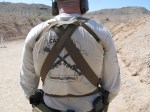
H-style support harness for greater comfort and stability than X-harness style.
Belt keepers on the front to hold the vest down and keep it from riding up.
I was able to used the vest at the Phoenix Rod and Gun 3 Gun Match
Local matches are organized practice/training sessions, and that’s generally what I use them for.
I Identified 3 things I needed to fix at this match
1) My shooting gloves had some fuzzy stuff on them that the velcro on my mag pouch flaps could bind to. It slowed down my reloads on one stage. I took a lighter to them after that stage to eliminate the problem.
2) I haven’t shot a Saiga in almost 10 months, I need to get used to the bore offset again with the red dot; more practice
3) My Saiga malfunctioned twice with failures to eject. I cleared them quickly by racking the bolt. The trigger was also behaving strangely. After the match I found that the right side leg of the hammer/trigger spring had moved out of position causing the trigger to reset slowly. I bent the spring and fixed it and it function tested fine after that.
Posted inGear, SAIGA-12|Comments Off on Coyote Tactical 3-Gun Trooper Vest
Action competition shooters have been using a support arm extended hold for some time now. The reason for this is it allows the shooter to drive the gun target to target faster with less over travel. The more mass that is forward on the rifle, the better this technique works. Extended hold has gained more attention recently with Magpul Dynamics training DVDs. There are also now multiple instructors that are former/active special operations that are teaching it as a practical technique.
In September/October of 2010, there was a debate raging on a local shooting forum about extended hold. Some people believed it was only for “gamers”, lacking in practical value, and did not offer an appreciable advantage over mag well hold.
Mark P. (one of my local shooting cohorts) and I decided to run a test to see how much faster extended hold vs mag well hold was; speed being the primary advantage to using extended hold. Here is his write up of the test.
——————————————————————————————
We would evaluate both methods under controlled conditions using a shot timer and film the event for posterity.
Four test subjects were used including a female with no experience. This was her first time shooting a carbine of any type and her second time on a shooting range.
The other 3 subjects had varying levels of commercial training and competition history. Of those, two were veterans with OEF/OIF deployments.
The nature of the exercise, to determine which ‘hold’ allowed the shooter to transition laterally from one target to another on a level surface. Near and far ranges were tested to get an overall evaluation.
The target used was an IPSC official CLASSIC.
To remove any variables, it was decided to shoot targets from left to right with one shot each.
No effort was made to penalize the shooter for missing the target (only the novice shooter had the occasional miss).
The participants made every effort to score an ALPHA hit as quickly as possible.
Equipment
Cav Arms lowers were used on three of the four weapons. A conventional lower was used on the last.
The female used a dedicated 22lr on a CA lower.
Two of the CA rifles had midlength direct impingement (DI) uppers with rail hand guards.
Cav Arms lowers are fixed A1 length with a 13” LoP.
The conventional lower had a carbine (DI) length upper with a surefire forearm with integrated light system.
All carbines employed the use of a red dot sight (RDS) and A2 flash hiders.
Drills
Drill One:
Conducted at a range of 25 yards with targets set at 15 yards apart . This created a shallow arc of movement.
Shooter centered between targets.
Shot strings was fired alternating between the extended and magwell hold.
The shooter started facing the left target and shot one round at each target.
Drill two:
Conducted at a range of 7 yards with the shooter centered between the 2 targets, thus creating an arc of about 160 degrees.
The shooter starts facing the berm center and upon the start signal, faces the left target, shoots and then engages the right side target.
The same protocol was used as drill one, varying strings between holds.
To determine if stock length had any measurable effect, I tested Drill two with the stock at full extension and again in its normal position.
Two subjects also ran drill two with body armor to determine it’s effects on the exercise.
Results:
The extended hand position on the forearm resulted in faster transition times for all four subjects. While there was the occasional string where the magwell hold was faster, by averaging the string times – the extended hold prevailed in every case. Anywhere from 0.1 to 0.29 seconds were gained by using the extended hold.
Granted, this was a small group sample with a narrow range of experience but we were able to see a trend developing.
Evaluators comments concluded that by using MW hold, the weapon would over track the target and extra time was necessary to recover.
The female shooter commented that by using the extended hold, the weapon was “more balanced.”
(Note; while the intent of using the 22lr for her was for familiarization purposes before using the center fire version, it was decided to remain with the low recoiling carbine to stay consistent with her experience level. She did decline the opportunity to fire the full size version after the testing).
When wearing body armor, the center of gravity of the weapon is placed forward away from the shooter. Adjustable stocks can compensate for this and hold the advantage for shooters of varying stature.
What does this all mean and why should I care?
To paraphrase Magpul Dynamics, a gunfight is a “time-is-life” scenario, do you want to give away up to 0.2 seconds to your opponent ? The faster you eliminate your opponent – the less time you spend engaged in that fight. It may not reduce your injury threshold, only your exposure time in the event for that particular target. As a shooter, it is up to you to determine the right ‘tool for the job’ and evaluate what works best for your particular circumstance. The magwell hold is still viable, especially in tight/confined quarters using a sub gun for which it was developed. It remains up to the operator to know when to apply each method.
Raw results
Shooter drill Extended Magwell Conclusion
String Remarks
1 Matt 1 2.22 2.73
2 Matt 1 2.35 2.45
3 Matt 1 2.16 2.48
4 Matt 1 2.55 2.15
5 Matt 1 1.99 2.22
Total 11.27 12.03
Avg. Difference 0.152 Extended Faster
String
1 Maya 1 2.51 3.05
2 Maya 1 2.68 2.7
3 Maya 1 2.79 2.73
4 Maya 1 2.76 3.25
5 Maya 1 2.00 2.58
12.74 14.31
Avg. Difference 0.272 Extended Faster
String
1 Russell 1 2.01 2.35
2 Russell 1 2.06 2.11
3 Russell 1 1.96 2.01
4 Russell 1 2.03 1.99
5 Russell 1 2.04 2.15
10.1 10.61
Avg. Difference 0.102 Extended Faster
String Drill Ext MW
1 Mark 1 2.46 3.08
2 Mark 1 2.23 2.32
3 Mark 1 2.15 2.56
4 Mark 1 2.15 2.21
5 Mark 1 2.33 2.19
11.32 12.36
Avg. Difference 0.208 Extended Faster
1 Matt 2 2.44 2.52
2 Matt 2 2.23 2.25
3 Matt 2 2.16 2.36
4 Matt 2 2.06 2.28
5 Matt 2 2.16 2.2
11.05 11.61
Avg. Difference 0.112 Extended Faster
Mag well hold has it’s place, it is generally most effective with short guns with less mass out front and correspondingly with forearms that are too short to hold effectively. It can also be a necessity if someone is forced to use a stock that is too long, while wearing armor or cold weather clothing, particularly with an optic with limited eye relief. In that set of circumstances holding out far on the fore end is a physiological impossibility for most people, and mag well hold is required. Another valid reason to run mag well hold is because it allows the shooter to square up and present more of their armor to a potential threat, and access some of the controls with the support hand.
I personally prefer extended hold because it is faster and is more consistent in viability across a wider range of shooting problems. The support hand is always in the correct location to activate light switches. For the circumstances where it is necessary to bring the support hand in closer such as going kneeling or prone, it is simple to slide the hand back while moving into position. Likewise when shooting on the move at extreme angles the support hand can be collapsed in to allow for proper body geometry for a wider arc of fire.
Understanding the why behind different techniques is a critical component of knowing when they should be employed. There are advantages and disadvantages to every technique, its up to the shooter to determine which one most effectively solves the shooting problems they may face.
Posted inTraining|Comments Off on Speed Test Extended Hold vs Magazine Well Hold.
I’ve shot hundreds of 3-Gun Stages over the past 10 years. National level matches allow match organizers the time and resources to do things that aren’t possible in club level events. There have been some pretty cool stages at these larger matches, but none have come close to the level of awesome as the blind stage at the 2009 Ironman 3 Gun Match.
We knew very little going into this stage. We would only be bringing our pistol with us, and we would find pick up guns throughout the stage.
I found and neutralized all the targets
I liked this stage for several reasons
1) It tested the shooter’s mindset in dealing with an unknown situation, and ability to scan for targets
2) The use of pick up guns was appropriate and tested the shooters ability to adapt to equipment other than their own. The size and distance of the targets was reasonable given that we were not using our own equipment.
3) This was a truly unique stage design and scenario, and I’ve not encountered anything else of the same size or scope before or since.




 SinistralRifleman
You must be logged in to post a comment.